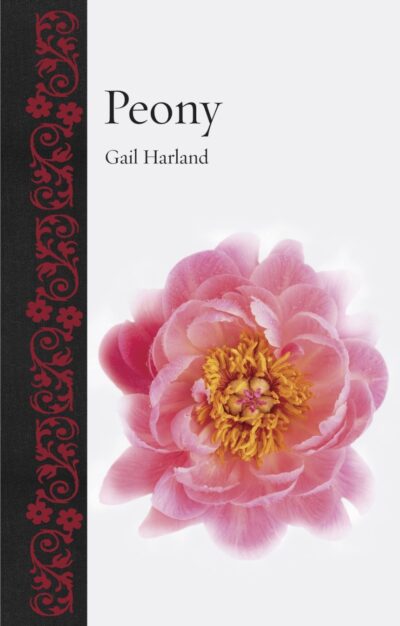
I was delighted when I opened the envelope containing a review copy of Peony. Out came a lovely hardback with a peony in full bloom on the cover. It’s precisely this voluptuousness that attracts so many. The author, Gail Harland, mentions this. Disappointingly, though, her history of the peony in botany, art, music and the nursery trade has none of the same appeal. The prose plods along from one flat sentence to the next.
First we learn about the botanical attributes of the only genus in the family Paconiaceae and where it grows across four continents (Europe, Asia, North America and North Africa). These early pages have lovely photographs of some of the species detailed: in January 2024, Kew’s Plants of the World Online listed 36 species.
The next chapter, ‘Queen of All Herbs’, is an account mainly of medicinal uses of the plant since ancient times. Harland cites contemporary science to say that the efficacy, particularly of the root, for treating various ailments has not been proved. I hope that fact can be deployed to protect native populations under threat from people in China and Bulgaria who continue to collect the plants for medicines, although old beliefs can be hard to budge. In this chapter, Harland quotes another writer, Jane Fearnley-Whittingstall, who cooked and ate a peony root during her research, reporting that the taste was ‘reminiscent of turnips soaked in wallpaper paste mixed with turpentine’. This sort of language would have enlivened the book.
A puzzling aspect of the publication is the use of images. The blurb boasts 106 illustrations, 99 in colour. In the chapter ‘King of Flowers’, Harland makes many references to pictures of the flower. Europeans first saw it not as the actual plant but as depicted on Chinese porcelain in the 16th century. That point is not accompanied by an image, nor do we see one reproduction of Redouté’s illustrations or Manet’s gorgeous renditions of the bloom. In a later chapter devoted to ’Picturing the peony’, more illustrations would have enhanced the text. None appear, for example, from the art of botanical illustrator Alfred Parsons (who worked with William Robinson); the pioneer Japanese photographer, Ogawa Kazumasa; contemporary Ukrainian sculptor Vladimir Kanevsky who creates porcelain flowers.
I learned plenty from Harland about the species of peony, their cultivation and hybridisation, and the plant’s cultural connections. But some of the author’s accounts feel tangential. The story about Sarah Bernhardt does not explain why Lemoine, the plant breeder, named his cultivar after the tragedienne; it only states that, like the performer was in her day, the plant is one of the most loved herbaceous perennials. And when Harland discusses broader historical themes, some seem more connected to the peony than others.
Peony is full of facts and has an index to help you find the information you may be looking for. What’s disappointing is that it’s all rather prosaic, in such contrast to the flamboyance of the flower that can so intoxicate its admirers.
Gail Harland, Peony, Reaktion Books, 2025 is available from https://newsouthbooks.com.au/books/peony/