
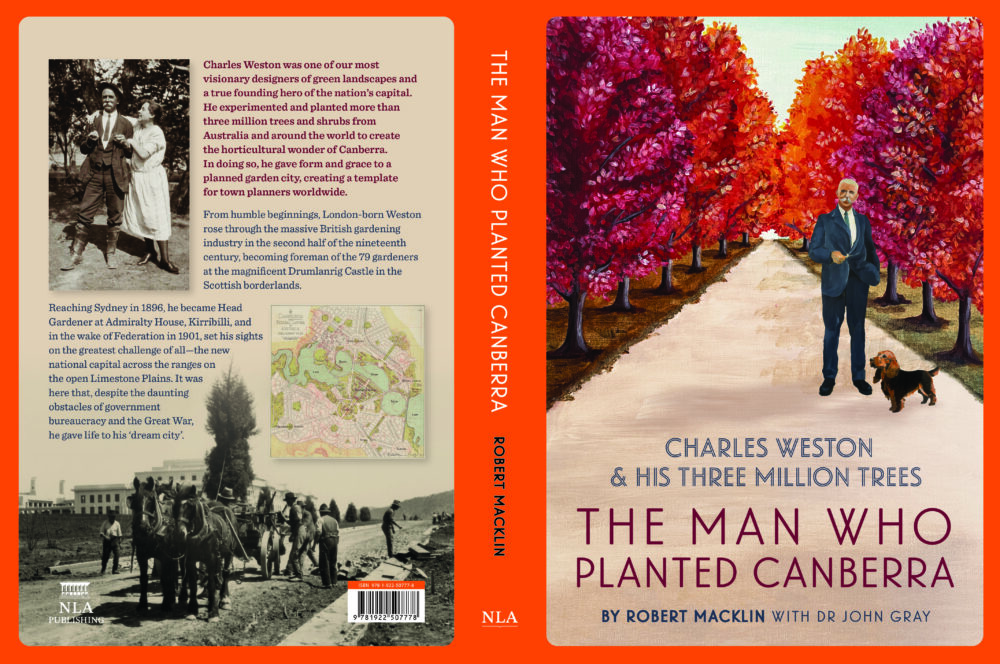
My review of The man who planted Canberra by Robert Macklin first appeared in The Weekend Australian on 21 February 2026.
Walk into any bookshop today and you’ll be surprised by the number of books about trees. Publishers tell us too that anything about trees will sell its socks off. It make sense – especially in a city like Canberra where trees are about much more than shade and beauty. In the national capital trees have long been central to the politics and philosophy of the place In recent years the balancing act between ensuring the three million trees planted almost 100 years ago do not become a fire hazard and maintaining the unique appeal of the city has been intense.
Time to step back and take a look at the work of the man whose impact on Canberra’s development in the 20th century has been all but forgotten. The publication last year of The Man Who Planted Canberra – a biography of Charles Weston – recovered this remarkable slice of country’s history. I was closely involved in the project to bring Weston’s work to a new generation. Author Robert Macklin had only recently completed the book when he died in January. He had had an extraordinary career, resulting in more than 30 books and many films, plus long stints in journalism and as press secretary to Country Party Leader Jack McEwen. This fine biography used a scholarly work by the late Dr John Gray as a starting point.
Canberra, Australia’s only ‘garden city’, and one of the few world capitals designed from the ground up, is usually credited to the American Walter Burley Griffin and, if you are being at all fair, to his wife Marion Mahony Griffin. To an extent that is correct. But an ignored landscaping genius, Thomas Charles Weston, really changed it into a true garden city. When he died, the Sydney Morning Herald obituarist described Weston as ‘a poet, an artist and a tree-planter in one. His message to the nation, his melodies, his pictures, he pieced together with limb and leaf.’ Yet Weston, born in England in 1866, of very humble stock, left school at 13 and became the brilliant plantsman he was because of apprenticeships with one of the best Scottish garden managers and through absorbing as much as he could of the great self-improvement training of the late 19th century.
The Weston book traces not only the making of the young gardener/forester in England and Scotland, but his rapid elevation when he came to Australia. At 29 years of age, he was foreman in the great Scottish estate of Drumlanrig. With the pressures of the British class system, that would have been as good as he could possibly get. Armed with extraordinary references, in 1896 he migrated and immediately found work as a gardener of great skill. Weston arrived as the colonies of Australia were roiled by debates about Federation and as Macklin says was ‘well positioned to view the political pantomime’.
Weston spent 15 years in Sydney. After a brief period in a private garden on the remote north shore, he applied for a job more suited to his talents at the (Royal) Botanic Gardens on Camp Cove. His timing was fortuitous as the then new director, Dr Joseph Maiden, also an Englishman, quickly recognised his skills and appointed him to manage the gardens at what later became Admiralty House. Macklin writes:
By 1907, Weston had transformed the gardens. He’d also expanded and broadened his knowledge of Australian horticulture through research, reading and experimentation in conjunction with the Sydney Botanic Gardens under Maiden’s direction, covering Australian flora, public parks, afforestation and conservation.
Around Australia the debate as to where the new national capital should be based, and later how should it be designed, raged on. Weston watched with great interest. During this time he was, with the strong support of Maiden, appointed in 1908 as head gardener of the then federal Government House adjoining the Botanic Gardens.
By then, Weston had married another English migrant, Minimia Cockshott, and with their three daughters they lived near Macquarie Street. The girls grew up playing in the little-used Government House grounds their father managed.
Clearly Maiden was hugely impressed with Weston’s skills, despite his limited formal education. At one stage Maiden wrote: ‘No officer in my department is better acquainted with the literature and practice of Mendelism’. William Bateson, the English scientist, had coined the word ‘genetics’ and used it publicly in 1906 for the first time, so Maiden, the scientist, was basically saying Weston was the best geneticist he knew.
These skills would emerge when Weston moved on to his role in Canberra. In 1911, the federal government sought his expertise to design a nursery for the capital; a site had been finally settled and a design was under way. On 27 April, 1911, he visited the site, travelling by train and stage coach from Queanbeyan. Maiden then encouraged him to transfer to a higher paid job in charge of the NSW State Nursery at Campbelltown, while still advising the federal government on the best way to establish the Canberra nursery. In May that year the decision to award the design prize for Canberra to Walter Burley Griffin from 137 international and local submissions was announced, but it would be another 15 months before the architect came to Australia.
Weston visited the site of Canberra four times during 1912 and produced plans for the testing nursery by September that year. He was clearly a horticulturist (though today we would call him an urban forester) who believed in researching through species testing before planting. Canberra was a tough environment to grow trees in as the central valley was a natural frost hollow and the limestone plains would only support a range of trees and shrubs that could cope with cold frosty winters and hot dry summers on tough soils. As well, the great Australian rabbit plague was hitting its peak.
In January 1913, then prime minister Andrew Fisher (a Scot) pressed NSW premier James McGowan to agree to Weston’s formal transfer to become officer-in-charge of the Afforestation Branch in the territory. Five months before Griffin, he arrived to work full time in Canberra, despite having told Minimia: ‘None of the other top horticultural people wanted to go because they thought (the project) would be a failure’. This meant a long separation, only mitigated with rare visits by train, from his family in Sydney. Weston lived in a two-roomed hut; there was no married accommodation available for years. He so valued education, which he had sorely missed, that he insisted his girls get the best possible, which meant staying in Sydney where his oldest daughter went to Fort Street High school, then on to mathematics at university and a distinguished career in education.
Macklin’s rich narrative documents the wonderful achievements of Weston, at times in spite of, and at others in close collaboration with, Griffin. The architect had done a brief course in landscape design in Illinois along with his architectural studies and he and Marion Griffin were certainly deeply interested in Australian flora, but with nowhere near the practical skills let alone the formal knowledge of plant selection and management. Disagreements over species selection cropped up from time to time especially over a spectacular ‘failure’, which stumbles along to this day. On the eastern side of what is now Canberra Airport, on the shores of what was proposed to be the east basin of the lake, Griffin insisted upon a plantation of sequoias, a beautiful species of very large trees from California. Weston thought they would not succeed on that site, most died very quickly and a tiny residual and miserable relic of the plantation still exists.
Weston plugged on through tough periods, losing many staff to the First World War, dealing with rabbit plagues and some very rugged planting sites. He even developed a system involving the use of gelignite to blast small holes in some of the most difficult places. His plantings of advanced trees, especially around what is now Old Parliament House and inner Canberra suburbs like Kingston, Barton and Reid, are testaments to his skills. He persevered against not only sometimes misdirected ideas of Griffin but also perpetual bureaucratic and overarching political squabbling (sound familiar?), which gives this book its rich cultural history. Weston also managed to bring some good conservation ideas into play: he stopped the widespread ring barking of trees by graziers and also encouraged landscapers not to plant large areas of grass on verges or even playing fields. He was concerned there would not be enough water to maintain them…and he was right.
The Griffins’ struggles with both bureaucracy and politicians to protect their designs have been well documented. But Weston’s steady and hard work has not been given the prominence it deserves. He developed 50 plantings in nine separate zones of the emerging capital, including major commercial pine plantations and even a proposed commercial cork oak plantation. As well, he did landscape designs and plantings for what became the Governor-General’s residence and the provisional Parliament House. His work was both broad in scale, such as the pine plantations at Stromlo, and highly detailed like the 25,000 tulips he planted in 1925 for the grounds of the Hotel Canberra. His effort to mitigate the winds of the limestone plains by judicious intensive plantings led to him building major shelter belts for key buildings and even suburbs.
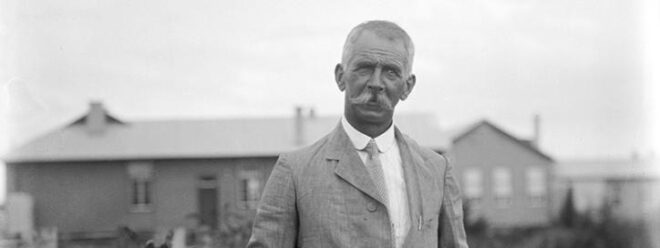
Around the emerging Parliament House Weston used a technique for relocating large trees using a horse-drawn Barrow tree-lifter, which he would have known from his apprenticeship days. And in his later years, according to Dr John Gray, he almost certainly designed the plantings along Anzac Parade leading to the War Memorial.
By 1926, when Weston reached the mandatory 60-year-old retirement age, he had overseen the planting of almost three million trees. He retired to Turramurra where he continued to breed plants. He was called back to Canberra for the opening of Parliament House, where his skills in floristry were once again tapped. Weston created not only formal flower arrangements but also posies for the Duchess of York. Later her husband, who became King George VI, presented Weston with an MBE. The royal visitors and politicians then dined at tables, which Weston had decorated with flowers, while he and his daughter went off ‘to Sergeants’ for lunch. When he died in 1935, Weston’s ashes were scattered on the Parliament House gardens. His widow, Minimia, received the same honour 20 months later, the first and only time this honour has been extended.
The Man Who Planted Canberra: Charles Weston and His Three Million Trees was published by the National Library of Australia. The project received support from the Kindred Spirits Fund.