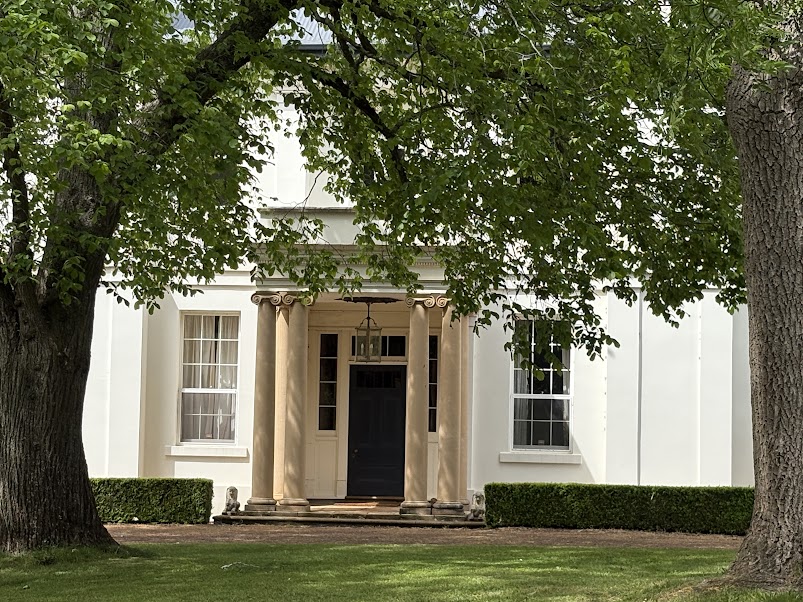
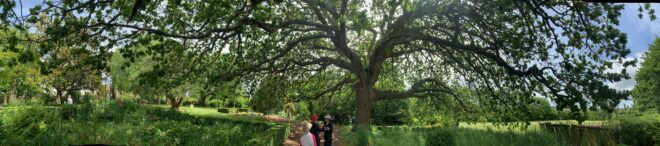
Last spring members of AGHS Tasmania Branch visited Longford Hall in Northern Tasmania. The property, first established in 1820s, has variously been a boys’ school with farm, a girls’ school, a Carmelite monastery and, at times and currently, a private residence. The property is listed with Tasmanian Heritage. The current two-storey house, described as an Old Colonial Georgian house was built in about 1850, with Italianate detailing added during the Victorian era. The extensive gardens were established in the mid-19th century and have many magnificent trees including a yew and a magnolia (Magnolia grandiflora) that are more than 100 years old. There are also a walled garden, arboretum, cherry walk, lily pond, formal garden with fountain, fruit trees and a ‘secret garden’. Pride of place, however, goes to the English oak (Quercus robur), at the front of the house, which is said to have been planted in 1836. There are two slightly smaller ones beside it.
Oak trees mature at 75 years, and have an average lifespan of 150 to 250 years, although the oldest are more than 1,000 years old. Oak trees are native to and widely distributed in the northern hemisphere, with more than 500 species, both deciduous and evergreen. They have always been valued highly for their many uses – timber for building, tools, cooperage and shipbuilding; bark for tanning, shingles, cork and medicine; galls formed by wasps for ink (signatures on the Magna Carta and Leonardo da Vinci drawings are done with such an ink) and acorns for food for livestock and humans.
They are associated with religion and mythology (usually gods of thunder), in history and culture (the Royal Oak in Britain, the Charter Oak in the US and the Guernica Oak in the Basque country) and in heraldry to symbolise strength and endurance. Oaks are the national tree for many countries including UK, Germany and Poland (Quercus robur), US (various species of the genus), Spain (Quercus ilex), Ireland (Quercus petraea) and Jordan (Quercus ithaburensis).
Today we generally consider an oak tree as a beautiful ornamental tree for a large garden. However, their most important feature is nurturing wildlife. The more ancient an oak tree becomes the more life it can support from the tips of its leaves to the ends of its roots. It is estimated that they support 2,400 species of insects, birds, small mammals, fungi and lichen with food, shelter and a place to breed. Even when an oak tree dies, the dead wood continues to provide habitats for wildlife including beetles, birds and many species of fungi. There is no other genus of plants that supports the number of species that oaks do. Because of their fundamental role in maintaining the diversity and stability of an ecosystem, they are considered a keystone species.
Oak species have been identified in the fossil record going back 56 million years but, unfortunately, almost 31 per cent of oak species are threatened with extinction and 41 per cent are of conservation concern due to climate change, invasive pests and habitat loss.