

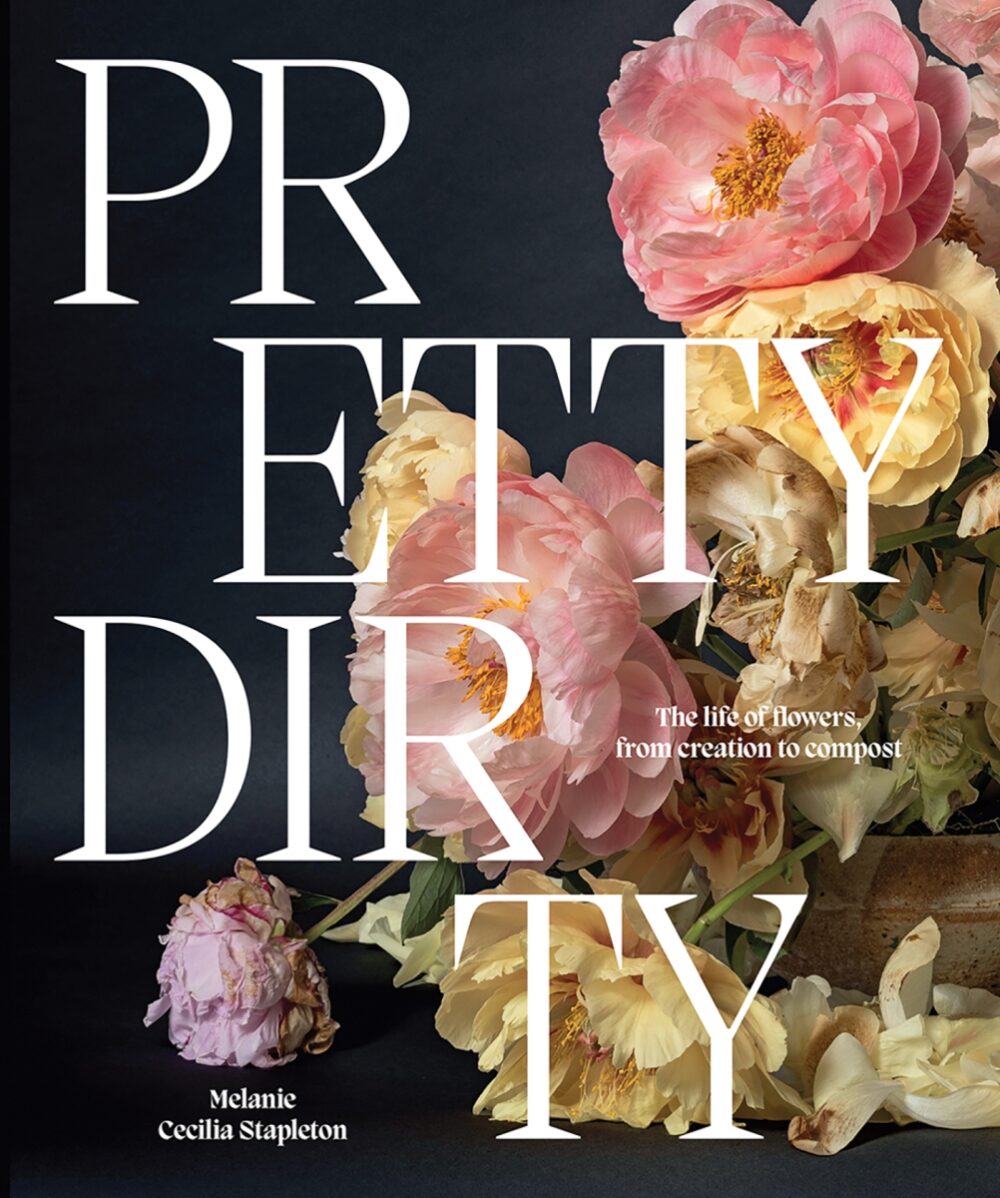
PRETTY DIRTY The life of flowers from creation to compost by Melanie Cecilia Stapleton, Hardie Grant Books, 2026
At first glance it is easy to classify this book as a coffee table book full of glorious floral photos, which it has in abundance, but it also contains very stimulating text by author Melanie Cecilia Stapleton that offers us an all-too-rare insight into how the floral industry operates.
Stapleton is a founder of Cecilia Fox, a creative floral studio in New Zealand she has established after spending several decades practising her artistry around the world and working closely with other floral artists. She is now one of the most respected florists in New Zealand and Australia. Her creative energy and enthusiasm shine through in the book and indicate a deep respect for the past, present and future of the natural world.
COMMUNITY, CREATIVITY, COMPOST: Stapleton says ‘these three words sit at the centre of my practice and are the quiet architecture behind this book’.
A tireless advocate for making the flower industry more holistic, Stapleton is intent on addressing the whole system rather than just individual parts. After more than 20 years working in the floral design world, she believes some practices are no longer fit for purpose and must be changed so that both the art and business of floristry work together as stewards of the natural world.
To encourage us also to do this, Stapleton divides the book into six chapters, each highlighting key aspects of the ‘pretty dirty’ movement. As a bonus, these chapters are interspersed with interviews and short articles on a variety of horticultural subjects including the rose, fragrance, small-scale growing, adventures in rule breaking, and the universe in a single flower. Superb garden images feature throughout.
In the first chapter, ‘Growing’, Stapleton presents the life of a flower farmer as opposed to the more traditionally recognised farmer growing food to feed or clothe us. While facing the same issues of weather, soil, water supply, pests, physical labour and consumer expectations, growing flowers to be picked is to grow purely for beauty. She interviews four flower growers to explore the challenges they face.
The second chapter, ‘Seasonality’, focuses on the difficulties and joys of working with the seasons. Here, Stapleton also writes about sustainable floristry practices and interviews three retail/event florists to give us further insight into the different ways florists operate and how many have expanded into event displays.
The chapter ‘Creativity’ explains how the floristry world has expanded from the concept of Eliza Doolittle selling bunches of violets to large-scale events that demonstrate the power floral design can have in a space and place. Fittingly, this chapter has the greatest number of illustrations of event floristry – all stunning in their scope and style. The three interviews in this chapter are with botanical artists who specialise in events.
Chapter four, ‘Community’, focusses on a world that most of us never see, the early morning at flower markets where the beauty of the flowers, the characters who sell them and the market layout, which Stapleton compares to a racetrack, make interesting reading. She writes: ‘It’s a haphazard ballet under the hum of industrial electric lights’. Three interviews with florists offer quite different perspectives on how they work.
The fifth chapter, ‘Perfectly Imperfect’, asks us to reconsider our concepts of beauty and perfection. While the typical commercial flower world revolves around the production of flawless identical blooms, Stapleton considers it more important to make commercially grown flowers look less perfect by blending them with foraged elements such as grasses and branches. This creates a wilder look more representative of the natural life cycle, reminding us that nothing remains constant; growing, blooming, ageing and dying. Short instructions on how to care for and condition flowers provide useful insights at the end of the chapter.
The final chapter focusses on compost, one of the author’s favourite aspects of gardening and a vital part of her holistic circle of life. Here she talks about the huge amount of green waste produced in the floral industry and the great opportunity it provides for composting. Stapleton also provides suggestions for recycling and composting on a domestic level. The two interviews at the end of the chapter are with major composting businesses Garbage Goddess in New York City and COM:POST in London.
Stapleton concludes:
When we make a business from the bounty and wonder of the natural world we owe it to ourselves, to our communities and to our environment to care and regenerate. To become a guardian and a steward of the natural world is not a burden but a responsibility,
an honour and a privilege.