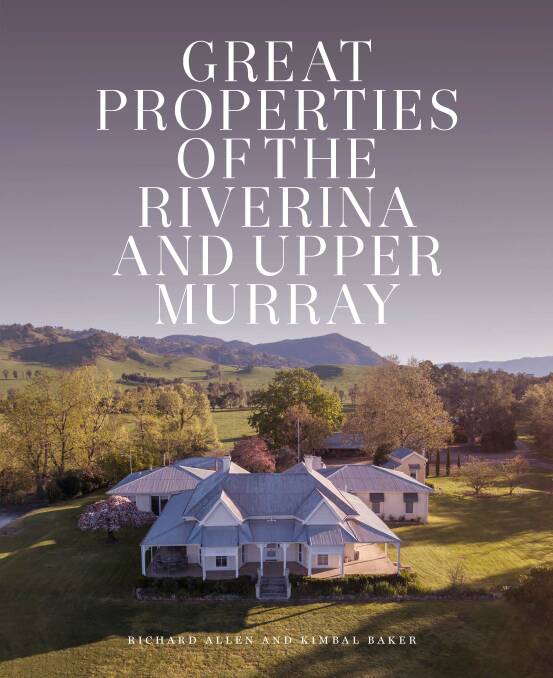
Great Properties of the Riverina and Upper Murray by Richard Allen, author, and Kimbal Baker, images, The Miegunyah Press, imprint of Melbourne University Publishing, 2025
Sixteen remarkable properties in the Riverina and Upper Murray are the focus of this third volume in the series of great Australian estates as seen through the lens of Kimbal Baker’s photography and the narrative of Richard Allen. These properties lie from the foothills of the Snowy Mountains to the Hay plains and the banks of the mighty Murray River. Most are found in southern New South Wales. Two are in northern Victoria. All offering an interesting record of the region’s farming heritage.
Pioneer pastoralists and graziers followed in the footsteps of explorers like Hume and Hovell and established holdings along the region’s waterways, building foundations for agricultural empires. The book traces the evolution of each property through the generations. While the stories focus primarily on the European settlers, there are subtle acknowledgments of the traditional owners. Many properties bear Aboriginal names such as at ‘Nap Nap’ – meaning much water – and here there is also a glimpse of the use of Chinese labour, likely drawn from the failing goldfields.
The Riverina and Upper Murray have attracted a cast of Australian characters over the years. Many of the properties have accounts of visits by notables such as Ferdinand von Mueller, Banjo Paterson, Tom Roberts, various members of the Royal family and an American President. The inspiration for ‘The Man from Snowy River’ was stockman Jack Riley, who was employed at Tom Groggin, his grave lies nearby, adding a layer of myth and legend to the region.
Landholders have always had to contend with fires, floods, climate change, feral animals, invasive weeds and the problems of succession. These days there is growing consumer demand for food produced with minimal artificial intervention, and a heightened awareness of the need to conserve native habitat. The use of modern technology has helped with efficiency, but tight margins and shifting ownership patterns are reflected in the changing face of farming. There are some properties now with city-based owners or corporate entities like S Kidman and Co and Australian Food Agriculture Co Ltd that offer diversification of risk, finance and economies of scale.
The two regions are well known for world-class Merino and cattle studs, and fine horses. At Khancoban they famously bred two Melbourne Cup winners. The enduring success of these properties is attributed to the continued exceptional quality of their livestock and the dedication of those who care for the land.
Each property is shown through stunning images of the surrounding landscapes, beautiful homesteads with their oases of lush gardens, all lovingly maintained down the years reflecting the enduring care and pride of their successive owners.
The book’s organisation alphabetically may initially frustrate those seeking information about a specific area. Also, there is considerable detail of the farming practices and not so much on the homestead gardens. However, the structure and the detail do not deter from enjoying the unfolding history of rural life, discovering unexpected connections and stories along the way. Ultimately, this coffee table book offers valuable insights into the innovation and resilience required to sustain quality food production in Australia, while preserving the land for future generations.