
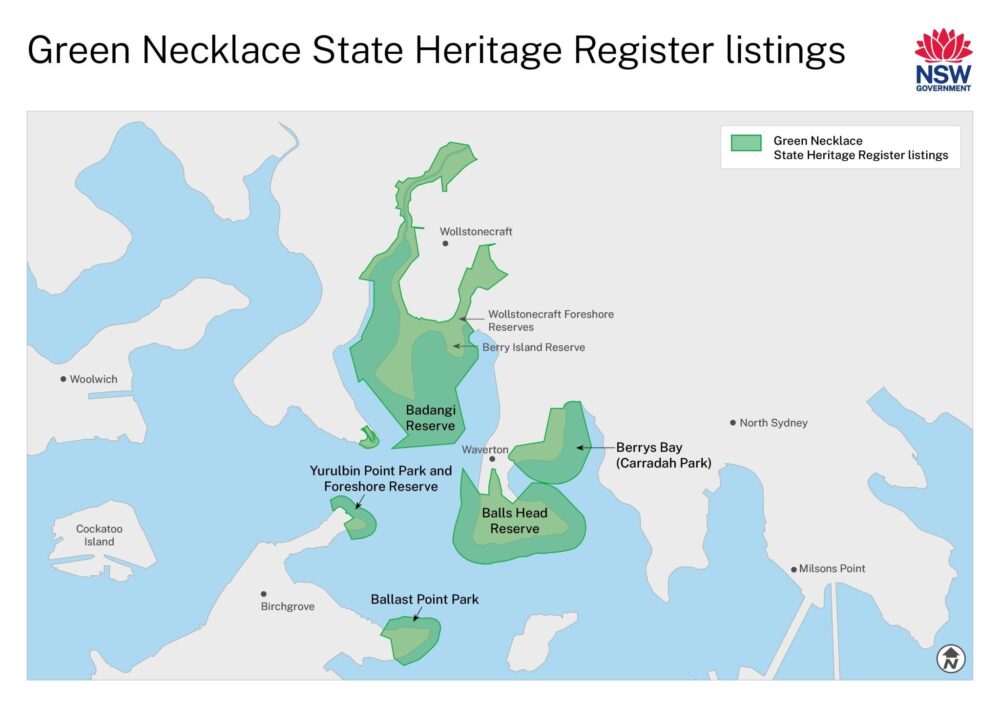
On the 25 July, two peninsular parklands on Sydney Harbour, Balls Head Reserve and Yurulbin Park and Foreshore, were added to the State Heritage Register (SHR) by the Hon. Penny Sharpe MLC, Minister for Heritage.
This occasion was momentous. Their gazettal followed the listing of Berrys Bay Precinct (Carradah Park) in March, Ballast Point Park in April and that of Badangi (encompassing Berrys Island Reserve and Wollstonecraft Reserve) in 2023.
Together, these listings have recognised the ‘Green Necklace of Sydney Harbour,’ the 2018 vision of the Australian Institute of Landscape Architects (AILA) Landscape Heritage Study which 10 nominated landscapes for the register. This achievement highlights the critical need to continue evolving our understanding of cultural landscapes, ensuring that their natural, cultural, and aesthetic values are protected for future generations.
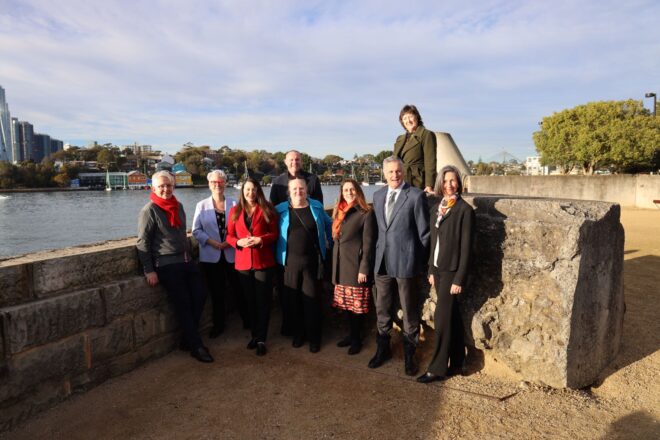
Inner West Council Mayor Darcy Bynes joined with the Minister to celebrate the occasion, posting on Facebook on 5 August:
Ballast Point and Yurulbin Park have both just been added to the State Heritage Register by Minister Penny Sharpe MLC. This marks the final transformation of these former industrial sites to some of the world’s most beautiful harbourside parks. These new protections recognise the unique cultural, environmental, and industrial histories of these sites, while safeguarding Sydney Harbour’s natural beauty for generations to come. The advocacy of so many local people including Tom Uren and as well as Paul Keating is what has led to this magnificent outcome. Thanks very much Minister Sharpe for making this happen.
Following the announcement, the concept of the Green Necklace and its parkland listings lit up the airwaves. Across all media, radio, television and socials, the listings were talked about and continues to be ignite the imagination of the public and government.
My article in the July issue of Australian Garden History provides background to the AILA study and those places put forward for listing (including ones that did not advance onto the State Heritage Register.
Realisation of the AILA study’s work is rewarding. It marks a pivotal step in raising awareness of cultural landscapes, which have historically been underrepresented in heritage listings. The project’s Landscape Lens approach has shifted the focus beyond traditional lot boundaries to a ‘whole of landscape’ view or understanding. It encompasses the broader ecological, cultural, visual and spatial values that define these landscapes. This aligns with the framework by the Government Architect NSW for Connection to Country, where ‘planning processes consider natural systems that include people, animals, resources and plants equally – similar to an Aboriginal world view – [an approach that] could make a significant contribution to a more sustainable future’.
AILA continues its advocacy for further nominations, aiming to protect and celebrate significant cultural landscapes, including those designed by Landscape Architects.