
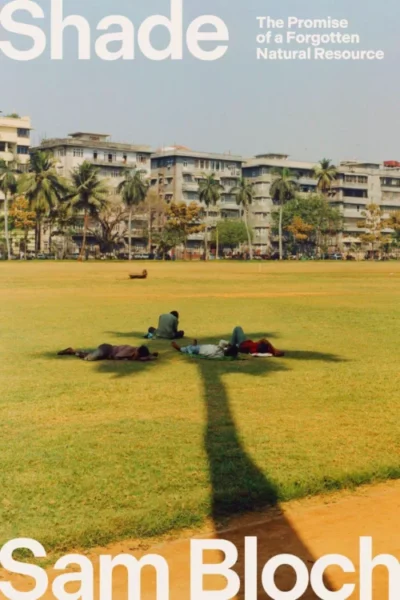
Shade – The promise of a Forgotten Natural Resource by Sam Bloch, Random House, New York, 2025
The author Sam Bloch is an American environmental journalist and his examples in Shade are largely based on observations from the United States, although the book does reference Australian understanding of sunlight and its heat in our cancer-aware “Slip! Slop! Slap!” messaging.
Gardeners know all about shade, its benefits and drawbacks for growing plants, and how it can affect the heat felt in our gardens. Bloch’s message with reference to people, not plants, is that excessive heat, especially through direct sun exposure, can kill: shade can save lives.
The book looks at how shade has been utilised throughout history from Mesopotamian cities with narrow passageways and courtyards to modern day Singapore’s extensive use of shade from green (trees) and grey (canopies and coverings) sources. Bloch also documents cultural bias against shade and its rejection in modern times, especially in open public space, along roads and in agricultural areas.
With recurrent heat waves, Bloch says shade is becoming increasingly important in both cities experiencing urban heat island effects, and also in rural agricultural areas where workers necessarily operate in the open. Shade provision and water coolers for worker hydration are set against the demands of piecework and quotas in agriculture.
Historic town planning and public health programs have established and perpetuated social and economic inequalities in terms of shade provision. In short, people in wealthier suburbs are cooler, and therefore safer from heat related deaths, not only through their ability to pay for artificial cooling but from provision of the natural shade of the developed urban forest. The poorer classes just have to deal with the heat, often outside because their homes are too hot inside, but without a tree canopy to help. While this polarisation appears starker in America, it is also present in Australia.
Extreme heat emergencies do not generally result in costly disruptions to economic activity or property damage such as those arising from hurricanes, floods or winter storms, although bushfires are now increasingly common, and not only in Australia. This lack of direct financial (as opposed to human) cost is noted as why shade to ameliorate extreme heat is not being prioritised by many governments. The common assumption that air conditioning will fix things also ignores the problems of energy grid failure from sharply increased energy use. Even if green electricity is used, the heat from inside urban buildings has to go somewhere, so air conditioning can make the city environment outside even hotter, requiring even more artificial cooling to be liveable.
The book concludes that architects and planners must now reinvent shade as an investment for the whole community. One solution is the planting of more trees that not only shade but also assist in CO2 capture. That is something we gardeners can understand and applaud.