

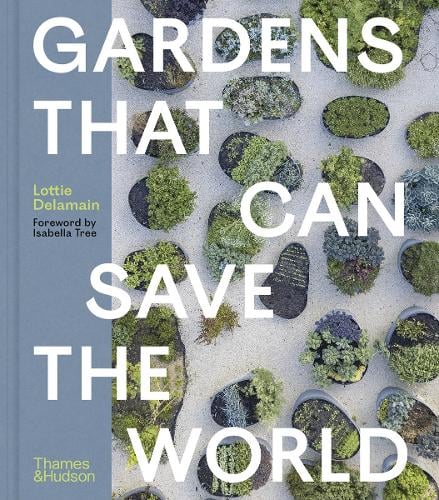
Gardens that can save the world by Lottie Delamain (foreword by Isabella Tree), Timber Press, 2026
Hope is a curious feeling. On one hand, it is desperately needed as a counter weight to despair and as a motivation for positive action. On the other, it can easily become the very thing that prevents us from taking action; a form of comfort and self-deception in the face of fear. As the writer Rebecca Solnit has said:
It’s important to say what hope is not: it is not the belief that everything was, is, or will be fine…The hope I’m interested in is about broad perspectives with specific possibilities, ones that invite or demand that we act.[1]
Designer Lottie Delamain’s new book, Gardens that can save the world, claims to be one such call to action by providing inspiration through the lens of the garden ‘seen anew’. In Delamain’s view, gardens can be so much more than status symbols or sites of human consumption. Instead, she positions them as catalysts for positive ecological and social change. Her book showcases 64 diverse garden projects, together with profiles of 10 practitioners, who collectively challenge our ideas of what gardens can achieve in a world increasingly characterised by crisis.
Organised into five thematic chapters and containing beautiful colour illustrations, the book treads the line between coffee-table publication and reference text. The gardens are, for the most part, inspiring examples that collectively blur the traditional boundaries between landscape architecture, garden design and social justice. Some of the examples are more effective than others at demonstrating innovation. A notable example is the Hermannshof experimental park in Germany, which shows how planting plans can consider the multifaceted relationships found within communities of plants. While ecology is certainly not a new idea, it is surprising that this relational approach is still not commonplace in many parts of the landscaping industry today.
Another interesting case study is designer Nigel Dunnet’s innovative use of succession planting at The Barbican Estate, a housing development in London. By creating attractive swathes of pioneer plants in the earliest stages of the project, Dunnett was able to ‘win over’ a community that had been resistant to change in the landscape. Meanwhile, the pioneer species created favourable conditions for the growth of a new climate-resistant perennial garden. This is a project that demonstrates that positive change takes time and sensitivity.
Still, some of the larger budget projects were less convincing as exemplars of sensitive design. While projects such as the High Line (a linear parkland in New York) and Bosco Verticale (a green, high-rise apartment in Milan) are visually impressive, they have also been critiqued for their intense use of resources and acceleration of gentrification: characteristics that may in fact make it harder to save the world.[2] Given that economic complexity often increases with scale, it may have been more effective for Delamain to focus on projects at the localised end of the spectrum.
These examples also reveal a broader issue: there is very little space given to in-depth discussions about how the gardens are embedded within their historical, social and economic contexts. This lack of grounding makes each page appear like an inspirational story in a social media feed, rather than providing any deep understanding of the relationships that have evolved over time. It becomes difficult to challenge the cultural perspectives of gardens as glossy, abstract images, when there is such limited engagement with situated knowledge.
While I enjoyed reading about the projects, overall the book felt a bit like ‘junk food’ indulgence. The reader is left wanting more, a bit undernourished and not quite knowing how to apply feelings of hopeful optimism. Whether such hope can be translated into specific actions will depend on the reader’s decision to walk away from the comforts of the coffee table, and do some more digging into these fascinating and multifaceted garden projects.
[1] Solnit, Rebecca. Hope in the Dark: Untold Histories, Wild Possibilities. 3rd ed., Haymarket Books, 2016
[2] Katie Jo Black, Mallory Richards. ‘Eco-gentrification and who benefits from urban green amenities: NYC’s high Line’, Landscape and Urban Planning, Volume 204, 2020