
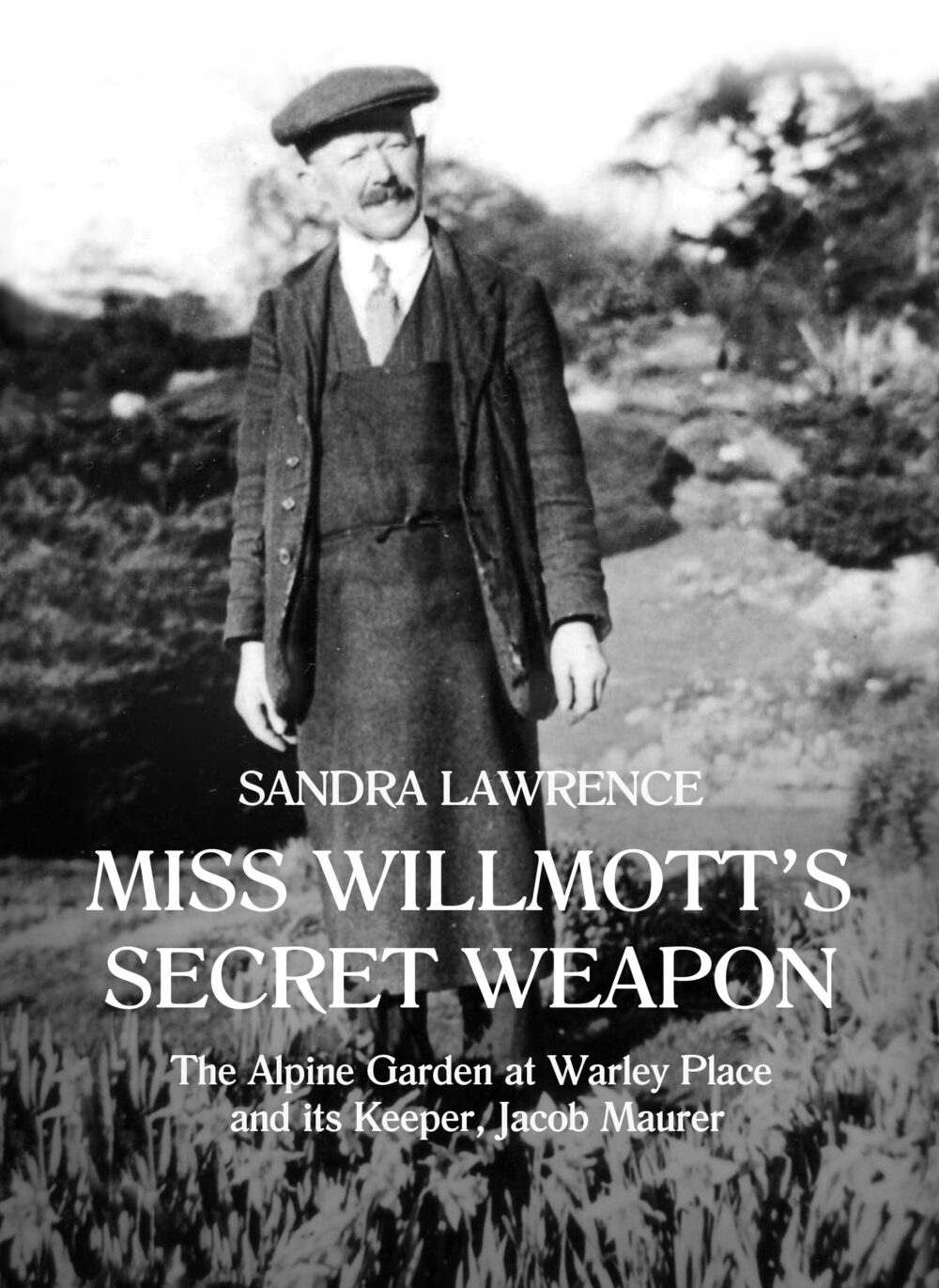
I have often thought those who did the actual work in the great gardens of the past receive very little, if any, of the credit. Sandra Lawrence’s account of Ellen Willmott’s alpine garden and its gardener, Jacob Maurer, is a welcome salute to one of these overlooked titans of horticulture.
Although only the ruins of Willmott’s garden at Warley Place remain, the huge amount of money Willmott lavished on creating her superlative garden is well known. The three-acre alpine garden, or ravine, was the most significant part of the garden. This account of its creation and its keeper is not only a fascinating read but a case study of Edwardian gardening and gardeners.
Nineteen-year-old Jacob Maurer came from Switzerland to work for Ellen Willmott in 1894. He devoted the next 40 years to developing and looking after her alpine wonderland, only to see it sold and abandoned on Willmott’s death. During this time he married, had 10 children, was widowed and remarried. He also cared for the many thousands of rare and delicate alpine plants in the ravine, nurturing and propagating them while dealing with his capricious employer.
Sandra Lawrence has been researching Ellen Willmott for many years. This led to the publication of her first book on a doyenne of Edwardian gardening, Miss Willmott’s Ghosts: the extraordinary life and gardens of a forgotten genius, in 2022 (see my review: https://www.gardenhistorysociety.org.au/2022/10/the-real-miss-willmott/). Lawrence has access to vast archives of documents, correspondence and photographs held within the extended Willmott family but did not confine herself to these. While Willmott’s alpine garden and Jacob Maurer are the nucleus of the book, the supporting chapters explore the Victorian love of alpines, contemporaneous alpine collectors and gardens, those who worked alongside Maurer, and Ellen Willmott’s gardening achievements and foibles, including chapters on her gardens in France and Italy.
The book is illustrated with historical and contemporary photographs that contribute to an understanding of the Warley Place alpine garden then and now. However, like Lawrence, we are left with niggling questions such as what was it like inside the Filmy Fern Grotto and was the Fern House part of the alpine garden at all?
Miss Willmott’s Secret Weapon is a sympathetic biography of its gardener, Jacob Maurer. On the darker side, it is an account of how poorly treated superb horticulturists could be and how much their livelihood was dependant on the whim of their employer, in Maurer’s case, a demanding and thoughtless one. South Lodge, the picturesque, thatched cottage assigned to the Maurer family may have suited the Edwardian notion of an appropriate alpine dwelling but it was cramped, damp and impractical for Maurer’s growing family. Despite this, Maurer family life is described as happy. I enjoyed learning that Maurer’s five daughters were all named after flowers – Rose, Violet, Lily, Marguerite and Iris.
Warley Place has been a nature reserve for many years. Volunteers there regularly uncover features of the old garden. Lawrence takes us with her as she contextualises these findings relevant to Willmott’s alpine ravine. For those who have visited Warley Place, it fosters a need to return.
Woven throughout the account are examples of the extreme dedication Maurer gave to the alpine garden which, at its peak, was visited by royals and the best known horticulturists in the world. One closes the book with a tinge of sadness, not only because this dedicated and wonderful gardener’s life ended so tragically, but also becaues the garden he and Ellen Willmott created is no more.
Miss Willmott’s Secret Weapon was published privately by Lawrence through her appropriately named Eryngium Press. It is available from the author at misswillmottsghosts.com.