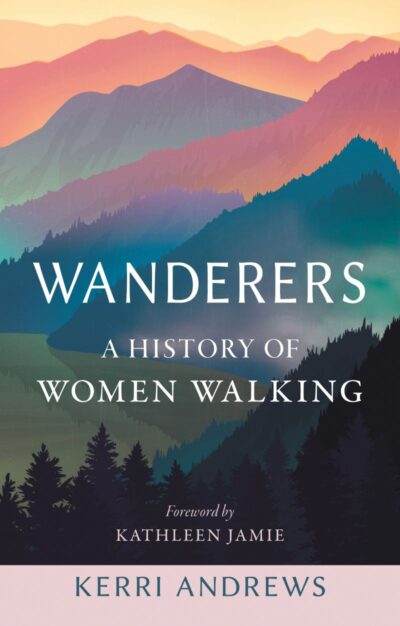
Kerri Andrews’ Wanderers: A History of Women Walking is a history spanning three centuries of women walkers. The book addresses a gap in the literature on walking, a subject traditionally dominated by male writers about male walkers. Andrews believes that women have often walked for different reasons than men, and that for the women she writes about, walking was essential to their sense of identity, physical and mental health, independence and creativity.
Rather than attempting a comprehensive history of all women who have walked, Andrews offers biographies of ten women walkers. The book contains a chapter on each of these women walkers, who are also writers. It explores the life, walking practices and literary work of each.
As a literary academic, Andrews has deliberately chosen walker-writers whose letters, journals, prose and poetry – both published and unpublished – provide the primary source material for her research. This reliance on written records explains her selection of subjects, who range from the polymath Elizabeth Carter, born in 1717, to the contemporary American writer Cheryl Strayed. Along the way she includes several well-known figures, including Dorothy Wordsworth (William’s sister), Virginia Woolf, urban flaneuse Anaïs Nin and the Scottish nature writer Nan Shepherd.
Andrews writes about the various motivations for walking. For Elizabeth Carter, walking promoted health and intellectual vitality; for Virginia Woolf, it stimulated creativity, provided an opportunity to compose her novels and provided relief from mental pressures; for Nan Shepherd, hiking in the Cairngorms became an intimate encounter with landscape and self. Cheryl Strayed’s long-distance hike provided healing and personal transformation following grief and loss.
For me, the book has one notable limitation. The landscape through which people walk is an essential part of the walking experience. As a long-distance walker, I know the most significant and enjoyable aspect of walking is a deep engagement with the landscape – its sensory qualities, history and culture. Andrews’ analysis instead concentrates on the personal benefits of walking, particularly its contribution to mental wellbeing, contemplation and creative inspiration. The book also contains frequent literary analysis of the subjects’ writing, which will appeal to readers interested in literature but is likely to be less relevant for AGHS readers.
The sections I enjoyed most were the excerpts from the women’s own writing. Descriptions of landscapes can be found in some of these excerpts, particularly those by nature writer Nan Shepherd. Shepherd was a mountain walker, who regarded the mountains as sentient, her ‘beloved places’. She wrote with sensitivity about the intimacy of the relationship between people and mountains. Her classic work, The Living Mountain, describes her journeys through Scotland’s Cairngorm Mountains, a landscape that is both breathtakingly beautiful and unexpectedly harsh. Her poetic prose beautifully describes the rocks, rivers, wildlife and hidden qualities of this remarkable environment. For me these excerpts are the highlights of Andrews’ book.
Wanderers contributes to the literature of walking. However, readers interested in exploring walking’s relationship with landscape may wish that Andrews had given greater weight to place itself, rather than focusing predominantly on the psychological and literary dimensions of walking.
For those who are interested in the connection between walking and landscapes, I highly recommend The Walking Cure by Annabel Streets. The book’s 20 chapters each focus on a different landscape type and present research-based descriptions of the beneficial characteristics of each landscape – an alchemy of landscape. For example, the chapter on flowers and meadows reports on a research finding that ‘in the presence of flowers, people stood more closely to one another, and spoke and smiled more readily’.