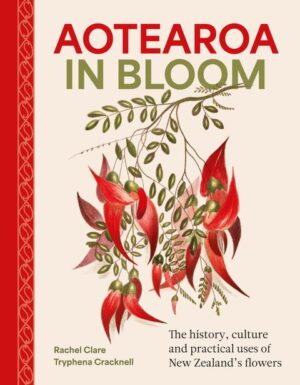
New Zealand’s native flowers have often been seen as less impressive than those in other countries but Aotearoa in Bloom, A history, culture and practical uses of New Zealand’s flowers by Rachel Clare and Tryphena Cracknell (2026) dispels this myth and reveals the floriferous feast within New Zealand’s shores.
As a garden historian, it was the stories of the flowers’ associations in both Māori and European cultures that appealed to me initially, but I found the book’s practical information just as engaging and it helped contextualise the plant in both the country’s history and its natural environment. For each plant there is a breakout, ‘What’s in a name’, that discusses the background to the plants’ Māori and European nomenclature, while ‘In the garden’ gives the reader advice on where to plant your chosen native flower and how it care for it.
New Zealand has more than 2,000 species of flowering plants and 80 per cent of them are unique to the country. Forty-seven are covered in Aotearoa in Bloom. The featured plants are divided into six chapters based on their natural locale – in the mountains, the bush, in scrubland, by rivers and swamps and in coastal areas. Botanical, Māori and Pakeha names for each plant are included and the stories of how they were named by New Zealand inhabitants forms part of the plant’s intriguing history.
The book is beautifully illustrated with works by well-known botanical artists such as Sarah Featon, Fanny Good, Emily Cumming Harris and Margaret Stoddart. Their paintings appear alongside a range of charming popular images including that of Hutu and Kawa, the pōhutukawa babies, which are modelled on May Gibbs’ gumnut babies.
Postcards, postage stamps, magazine covers, books and posters featuring the flowers cover more than 100 years of New Zealand’s social history. The authors have sourced historic photographs to support the history of each plant, including those of herbarium species collected by Banks and Solander. These sit side by side with sumptuous modern counterparts. In many instances a panoramic shot showing the natural habitat as well as close ups of the individual plant is included.
Aotearoa in Bloom introduces the reader to the delights of New Zealand’s tiny native orchids and the yellow variety of the ubiquitous pōhutukawa, New Zealand’s symbol of Christmas. The endangered nature of many of the plants, including the kaka beak, which appears on the cover, is highlighted and the authors encourage readers to plant these threatened species in their gardens. The last section of the book gives tips for propagation, the right plant for the right space and books for further reading.
We learn that the native koromiko (the Māori name for what was previously known as hebe and is now veronica) was sent to Māori soldiers by their families during the Second World War to combat dysentery and was also applied to wounds to help with healing, and that Marlborough rock daisies (Pachystegia insignis) were featured in British horticulturst Graham Hutchin’s garden at the Chelsea Flower Show in 1977.
One chapter is dedicated to Tecomanthe speciosa, said to be the world’s rarest plant. A single specimen was found on Manawatawhi Three Kings Islands in 1945 and today every plant of tecomanthe is descended from that one plant. I found this fact particularly fascinating as we have one in our garden! The original plant still survives on the Three King Islands.
The authors are well placed to write about New Zealand flora. Rachel Clare is the associate editor of Kiwi Gardener and Tryphena Cracknell, who has worked in conservation for many years, writes a regular column on native plants for the same magazine.
Aotearoa in Bloom is beautifully produced and will delight anyone interested in history, botany or New Zealand.