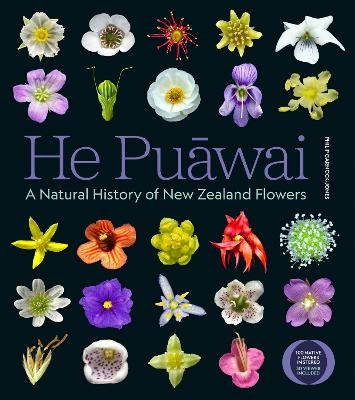
Philip Garnock-Jones, He Puāwai: A Natural History of New Zealand Flowers, Auckland University Press, 2025
Although it’s impossible to give an exact number, New Zealand has at least 2,200 native species of flowering plants. Eighty-five per cent of these grow nowhere else in the world. Philip Garnock-Jones, Emeritus Professor of Botany at Victoria University of Wellington, showcases 100 of these special flowers in the recently published He Puāwai: A Natural History of New Zealand Flowers.
New Zealand’s flowers have evolved in an unusual set of conditions, including the absence of long-tongued bees and the presence of nectar-feeding birds and pollinating flies. In part, He Puāwai is an exploration of the many ways New Zealand native flowers work to achieve pollination. The resulting flora has given New Zealanders a vibrant natural environment to enjoy.
Garnock-Jones’s tome contains more than 500 exquisite photographs, all taken by the author. Many New Zealand flowers are tiny, so photomicroscopy is used to show the beauty of each. 3D viewing glasses included with the book enable the reader’s enjoyment of the luscious stereographic images throughout.
The flowers are arranged by botanical name, with the family, Māori and common name included if available. Each flower’s story describes its structure and explains its functions. The hundred chosen flowers include many that are familiar such as harakeke or flax (Phormium tenax), the Marlborough rock daisy (Pachystegia rufa), mānuka (Leptospermum scoparium) and pōhutukawa (Metrosideros excelsa) as well as curiosities like the water-pollinated flowers of eelgrass (Zostera muelleri), bat-pollinated blossoms of kiekie (Freycinetia banksia), and the world’s smallest flowers, watermeal (Wolffia australiana).
Also included are the alpine buttercup (Ranunculus pachyrrhizus), a group which includes our most spectacular alpine flower, the Mt Cook buttercup, and the pretty little New Zealand slipper flower (Jovellana sinclairii) with its delicate white petals dotted with purple.
The 22 green text box pages scattered throughout the book provide extra information of general interest such as ‘what did the first flower look like?’, ‘butterfly and moth pollination’, ‘flower development’ and ‘gender dimorphism’. These add context to the featured flowers.
A glossary at the end of the book explains some of the less common terminology in the previous pages, but the plain language Garnock-Jones has used in his explanations makes He Puāwai an easy and enjoyable read for non-botanists as well as those more versed in the science. The book references other scholars’ research and there is an extensive bibliography.
Through the descriptions, but more particularly the photographs, in He Puāwai: A Natural History of New Zealand Flowers, Garnock-Jones has introduced readers to the vast array of beautiful, largely tiny flowers that flourish in New Zealand, many of which would be otherwise completely unknown to most of us.
Tim Park, the manager of New Zealand’s only botanic garden of native plants, Ōtari Wilton’s Bush in Wellington, writes:
This book, like no other, opens a microscopic window to appreciate native plants. The luscious detail, both in the crisp stereo imagery and in the carefully descriptive text, captures and holds the attention of anyone who has enjoyed the attraction provided by flowers. I predict this book will inspire another generation of botanists and nature lovers in Aotearoa. Not many books deserve their place as a textbook (which deepens our understanding of native plants) and equally as a (stunningly captivating) coffee table book.