
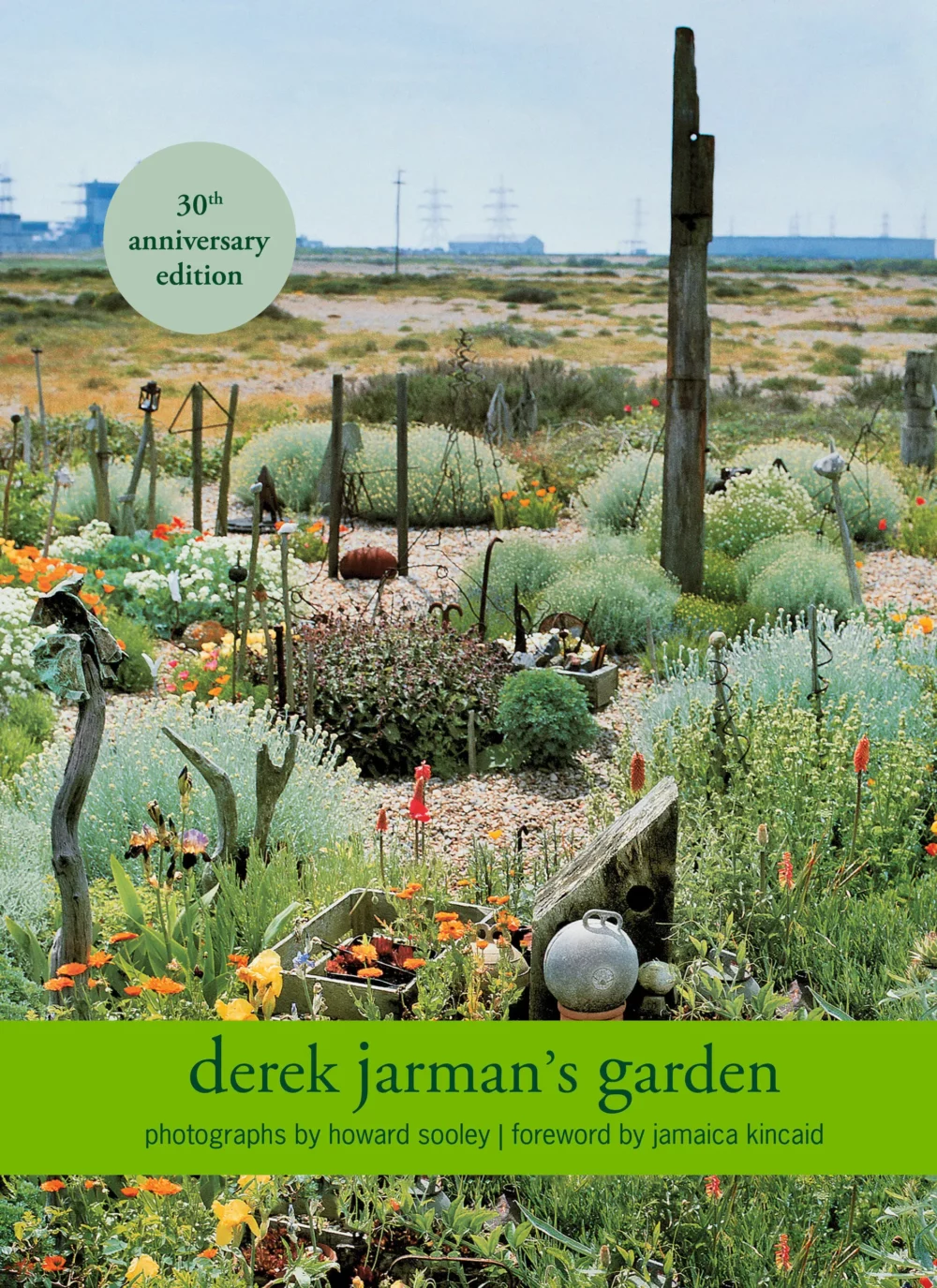
Derek Jarman’s garden at Dungeness has acquired an almost mythic status: a final garden made in the face of illness, exposure and political hostility. Thirty years after its first publication, Derek Jarman’s Garden, reissued by Timber Press with Howard Sooley’s photographs and a new foreword by Jamaica Kincaid, offers an opportunity to look again at the garden and the conditions under which it was made.
Jarman, an artist, filmmaker and leading figure in New Queer Cinema, acquired Prospect Cottage in 1986, shortly after being diagnosed with HIV, and began shaping the surrounding shingle with plants, driftwood and salvaged materials.
Prospect Cottage and its garden have become inseparable from the period of the AIDS crisis and the final years of Thatcherism. Queer lives were under sustained political and cultural pressure. Jarman’s films, writing and activism often operated outside mainstream institutions; the garden followed the same logic. Assembled with patience and close attention, it carries little of the polish and control associated with conventional gardens. It is shaped by endurance, decay, improvisation and care. In this context, the garden can be read as a modest but sustained refusal of the values that dominated late 20th-century Britain: efficiency, productivity and the reduction of value to economic terms.
Jarman’s own text grounds this reading. When he first arrived at Dungeness, he found ‘shingle with no soil’ and a site scattered with broken bricks and debris. Plants were ‘just plonked in and left to take their chances’. Sea kale, santolina, poppies and other hardy species were chosen for their ability to withstand wind, salt and drought. The garden was made through repeated acts of selection and placement. Driftwood and timber, part of what Kincaid calls ‘the detritus of the world’, became markers and sculptures. These arrangements carry symbolic associations, but they are also practical responses to the site. Nothing remains protected from the weather for long. Jarman notes that a storm in 1987 badly shook Prospect Cottage and damaged the garden. Timber decays, plants spread and disappear, the shingle shifts.
Kincaid describes the garden as ‘the ongoing-ness of life’ and the book’s design reinforces this idea. Its large format, spare pacing and close relationship between image and text create a record of looking, arranging, remembering and returning. Sooley’s photographs move between portraits of Jarman, close studies of plants and salvaged objects, and wider views of Prospect Cottage and the horizon. The alternation between black-and-white and colour photographs shifts the reader between archival record and the present tense of the garden. The Dungeness nuclear power station remains visible throughout. Its repeated presence places the garden within a broader setting of industrial infrastructure, environmental risk and political power. The reader is never allowed to remain solely with the intimacy of the garden or its maker.
This reissue also raises a question about the garden’s afterlife. Prospect Cottage began as a deeply personal project built with limited means. It is now a recognised cultural site, widely reproduced and visited. What began as an improvised response to illness, exposure and constraint has been absorbed into contemporary design culture, where its rough materials and informal planting are often repeated as an aesthetic for more privileged settings. The story of resistance now sits alongside preservation, heritage and institutional recognition.
Thirty years after Jarman’s death, the garden still commands attention because it has not settled into a single reading. It bears the traces of illness, labour and artistic intent. The wind, the shingle, the power station and the circumstances of its making all remain part of the work.