

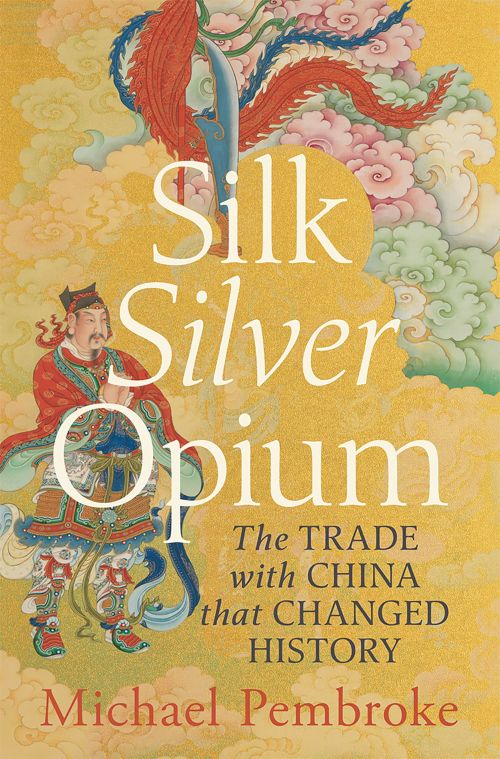
Michael Pembroke, Silk Silver Opium: The Trade with China that Changed History, Hardie Grant Books, Melbourne, 2025
This is a big book. Into its 341 pages Michael Pembroke, historian and naturalist, packs global, economic, political, religious and racial narratives from 247 BCE to the present day.
From the mid-1500s to the early 1800s, China was ‘the global centre of manufacturing production and the universal destination for much of the world’s ‘silver’ (i.e. money) sent in exchange for goods. In some ways, not much has changed, except that we now use paper money. The world’s economies are again in thrall to China’s gigantic economic power.
This book has a huge story to tell, or more accurately three interconnected stories populated by millions of unnamed people, numberless travellers and journeys, maps and mapmakers, and unimaginable cargoes of goods shipped from east to west. Each topic is narrated with flair; there is not a dull moment.
And there are gardens and gardeners.
Pembroke tells how Sir William Chambers’s 1757 handbook of chinoiserie dedicated to George III had a revolutionary impact on English gardens. From the 1760s onwards, the nurseries of Canton attracted plant hunters, many of whom were sent out by Sir Joseph Banks. ‘They brought back so many peaches, peonies, chrysanthemums, camellias, gardenias, azaleas, forsythias, wisteria and crabapples, clematis, pink jasmine and rhododendron…[that] their Chinese origins have been entirely forgotten and we have come to look upon them as our own’.
In the next century, by selling the ‘affliction’ of opium, the British drug traders James Matheson and William Jardine shared with the Christian missionaries the aim to open up the vast Chinese market Pembroke’s syntax slices through the hypocrisy of the West in lethal sentences such as this one: ‘The religious zeal of the American missionaries tended to exceed that of the British. And as for the opium traders, the British exhibited almost no virtue, while the Americans were inclined towards a false virtue’ .
The chief rogues and actors in China’s story, including the all-powerful, ‘brazen and unscrupulous’ Empress Dowager Cixi are similarly skewered: ‘Cixi appeared to worry about the wrath of Heaven and issued a decree halting the work “on her dream retirement home”. But construction was eventually continued, becoming a brilliant example of traditional Chinese landscape gardening and remaining a jewel of Beijing.’ The scale of all this was and is astonishing. The Summer Palace of about 350 ha extended for 10 km in every direction.
Equally astonishing is Pembroke’s account of the level of industrial organisation required to keep Chinese production going over centuries, and in defiance of temporary obstacles. In 1752, for example, the VOC ship Geldermalsen sank en route from Canton to Batavia, carrying 162,000 porcelains, including 27,531 dinner utensils, 63,623 teacups and saucers, 778 teapots, 19,535 coffee cups and saucers, 821 beer tankards and 606 vomit pots. All this was eventually recovered, It reached the London market in the 1980s and was sold at auction for 10 million pounds sterling.
This book shows how an already industrious society becomes an industrial one, shaping demand on an epic scale, at any human cost. Readers may recall their memories of the Chinese Pagoda at Kew Gardens, which George III had built in 1762, but they may be less familiar with the Chinese gardens and paths, zigzag bridges and Chinese pavilions of Washington’s Mount Vernon estate. The value of Pembroke’s new book, five years in the making, is an authoritative guide to the historical awareness we need to understand China and its place in the world.