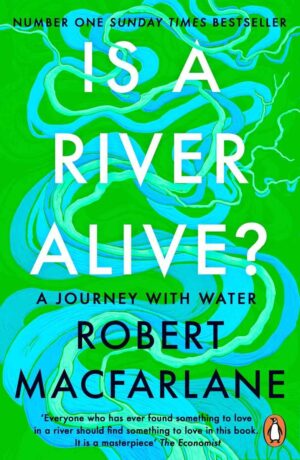
Robert Macfarlane, Is a River Alive?, Hamish Hamilton, 2025
Many AGHS members will know Robert Macfarlane’s beautiful prose from the two texts he wrote for the film/music of the Australian Chamber Orchestra productions River and Mountain, superbly read by the actor Willem Dafoe.
This book brought me literally to tears, shed for rivers but also forests, trees, fungus, indeed all aspects of nature. Its central question is one I have been asking all my long life and which, when raised with many, is greeted with scorn. But ultimately, and it still may be another long while, we humans do have to answer the question: ‘How can we set ourselves aside from nature?’
Eduardo Galeano, the Uruguayan writer, wrote:
We might find it bizarre…to think of a forest or river as having rights. Yet look how fully we have naturalized the idea that corporations have comparable rights to those of humans, ‘as if companies could breathe’! How strange that we should assent to this legal fiction but be surprised – even outraged – at the notion that a river might be other than a ‘piece of property’.
On his journey is northern Ecuador, where a cloud-forest and its rivers are threatened with destruction by gold-mining. Macfarlane quotes Galeano, who was asked to write in 2008 an essay on the Rights of Nature for the draft, new constitution of Ecuador then being considered.
The issues Galeano pursues go back further to at least, in modern western societies, Garrett Hardin’s 1968 essay, ’The Tragedy of the Commons’ and later Professor Christopher Stones’ Should Trees have Standing? (1974). Both of these writings have rattled around in my head for many years and each time I trot them out with a politician or economist (at the risk of tarring some ‘good’ people with a broad brush), I am usually made to feel like some sort of mad hippy. But the planet IS an ecosystem and all who travel on it are locked in, even politicians and economists, and their descendants.
In the 15th and 16th centuries, the terrible impact of the Spanish Inquisition was visited upon the people of the Ecuadorian lands. Anyone found “to have spoken with or to a river or worshipped a stream (was sentenced) to a hundred lashes. The Spanish literally flogged animism out of their newly colonised subjects…”. Or so they thought.
But the book is not all grim horror. Indeed the beauty and wonder of the three river valleys explored by Macfarlane with his lyrical prose are absolutely engaging. After Ecuador, he goes to the wounded rivers, creeks and lagoons of southern India and then northeastern Quebec, where a wild river – the Mutehekau or Magpie – is threatened with death by damming.
Macfarlane concludes:
After ten previous books and more than twenty years of writing, I have never before known a subject with the urgency of this one…Several times I have been taken right to the limits of my language and my beliefs – and then taken beyond them.
I urge all readers of this review to go on the trip with Macfarlane.