
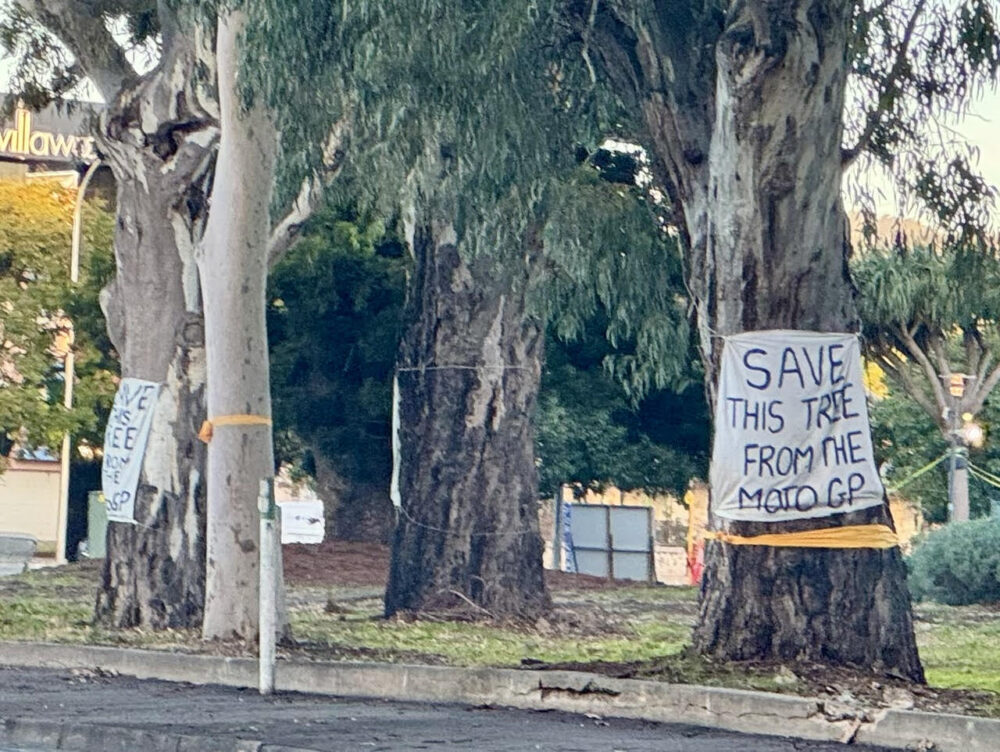
Protestors tied yellow ribbons and signs around large gum trees in the Park Lands that may be replaced by a circuit for the motorcycle grand prix. Photo S Marsden, 14 June 2026)
Colonel Light’s vision for Adelaide as the world’s first city within a park has been upheld for nearly two centuries. Is it about to be destroyed?
AGHS’s national advocacy sub-committee chair, Dr Jane Lennon, gave a talk to the AGHS South Australian branch in early May about the values of the Adelaide park lands as a national heritage listed cultural landscape and necessary actions to safeguard it. The talk was against the background of major redevelopment proposals that overrode local planning rules.
As the heritage listing states:
Adelaide is the only Australian city to be completely enclosed by park lands and has the most extensive and intact 19th century park lands in Australia. Adelaide Park Lands also has strong links to the Adelaide community as a place for many leisure activities and civic events. There is evidence that the first game of Australian Rules football in South Australia was played in the northern Park Lands in April 1860.
On 15 May the State government contractors proceeded with chopping down more than 500 mature trees in sections of the parklands known as Possum Park and John E Brown Park. These lands had been taken from control of the Adelaide City Council.
Premier Peter Malinauskas said that triple the number would replace them, as his government is committed to investing in the park lands to deliver improvements “for community use, for more trees, for more wildlife”. But now the government is planning to chop down 100 trees in another area of the parklands for the Moto GP race. More protests.
A Federal Court injunction is currently underway to test whether the redevelopment of the golf course to international standard is a controlled action under the Commonwealth Environment Protection and Biodiversity Conservation Act 1999 and whether this redevelopment and large-scale tree removal are likely to degrade, alter or diminish the National Heritage values of the Adelaide Park Lands and City Layout as a nationally significant cultural landscape.
In response to a letter to from Jane Lennon, on behalf of AGHS, to the South Australian Premier, the minister responsible, Nick Champion, wrote: ‘I can assure you that any decision by the Malinauskas Government to locate important public infrastructure within the Park Lands is always balanced with the aim to ensure there is zero-net loss of accessible Park Lands, while considering ways to improve access and amenity to surrounding areas.’ Here is the full text: Nick Champion’s reply.
As prominent South Australian historian, Susan Marsden, has pointed out to the government, public defence of Adelaide’s renowned Park Lands has a long history, with community groups campaigning for the protection of the park lands as far back as 1869. She joined the array of voices protesting against the latest threats to the park lands:
It is hard to comprehend why the state government should risk obliterating the character of Adelaide’s park lands by removing trees and adding buildings for two sports events when the city’s plan has drawn international acclaim, national heritage listing, and, in the long run, possible World Heritage listing. Will there be anything left of this renowned design by the time of SA’s bicentenary in 2036 (InDaily 2 June 2026).
As well as rallies, a ‘Stop the Chop – Save the Adelaide Park Lands’ hard-copy petition to South Australia’s Legislative Council has gained 16,000 signatures, well above the 10,000 needed for a parliamentary inquiry. The petition expresses ‘our collective and growing concern at the State Government’s continued legislated takeover of the Adelaide Park Lands to enable unprecedented and inappropriate development such as Festival Plaza, the North Adelaide Golf Course, and MotoGP.’
The Park Lands have ‘become a land bank for development’, trumping the ‘original vision of public green space for all’, and risking ‘the permanent loss of Adelaide’s most unique natural asset’. The petition can be downloaded for signing by residents of South Australia.