
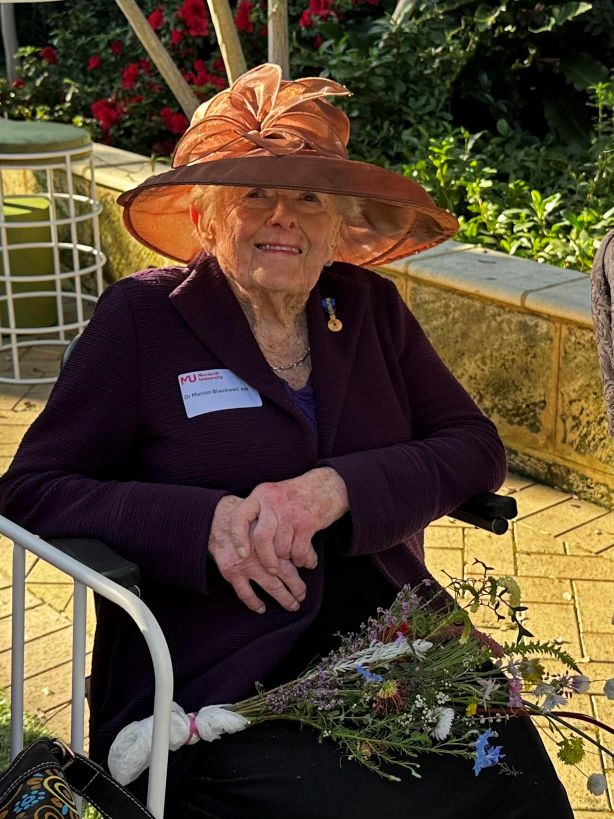
Dr Marion Isabel Blackwell died on 22 August 2026 in Perth aged 98. This tribute was written by Caroline Grant and Craig Burton. Caroline Grant interviewed Marion Blackwell for the AGHS national oral history collection in 2024. Craig Burton worked with Marion in Perth in the 1990s.
*
Marion will be missed by many and remembered for her extraordinary plant knowledge, landscape design legacy, wonderful mentorship and ability to draw attention to details in the world around us, especially to the beauty of Australia’s indigenous plants. She was born on 3 April 1928 in Manilla and grew up nearby on a station in the shadow of the Great Dividing Range in northern New South Wales. She was educated by Blackfriars’ correspondence school and radio broadcasts, before being sent to school in Sydney to complete her education for university entrance. As a child, she spent a lot of time exploring the places around her, caring for young kangaroos and tending her own garden. She gained a deep appreciation of the detail of the environment around her from an Aboriginal stockman. Marion was especially curious about trees and this interest remained with her throughout her life.
It was not easy for a woman to gain university entrance in the 1940s; Marion was declined entry to veterinary science. Instead, she enrolled in a Bachelor of Science majoring in plant physiology and ecology at the University of Sydney. As a new graduate she was asked to teach mycology at the New South Wales University of Technology (now the University of New South Wales). Her students included Second World War ex-servicemen, people older than her with a practical bent, whom she enthused with visits to bakeries and to observe winemaking and cheesemaking as part of their education. Her emphasis was on the importance of fungi to humans.
Marion moved to Western Australia with her pathologist husband John when he was invited to join the new Medical School at the University of Western Australia (UWA). She was pregnant with her second child but was soon employed by UWA to teach botany, which she continued to do part-time for many years. Marion was part of a group of local landscape architects who fought to establish an undergraduate course at UWA. She supported its implementation by Craig Burton and freely gave of her time to attend field excursions and share her amazing knowledge of indigenous plants and their ecological context. She was a generous spirit.
With her rural upbringing, enquiring mind and excellent plant knowledge, Marion was well qualified to conduct flora surveys in many remote areas of Western Australia. At one national conference, an Australian Garden History Society member asked, ‘Where is the woman who knows the desert flowers?’ They were referring to Marion who, when she attended AGHS conferences, was one of the plant experts who could be approached to identify plants, happily discussing the plant’s origin and story.
Marion had a long involvement with the Wildflower Society of Western Australia. She served on Western Australian Government committees dedicated to the conservation of native flora. She made a substantial contribution to the World Heritage listing of Purnululu, (the Bungle Bungles) in the Kimberley region of Western Australia.
Among her accomplishments as a landscape architect practising in Perth are the Harold Boas Gardens on Wellington Street and the landscape of Murdoch University, for which she was recognised in 2024 with the renaming of a courtyard as the ‘Marion Blackwell Garden’. One of her lesser known but important achievements was saving the historic Cloisters fig tree (Ficus rubiginosa) when its roots were damaged during the construction of Mount Newman House (now QBE House) in St George’s Terrace in the early 1970s.
Marion alerted people to the early garden history of Australia. During her botanical surveys in remote areas of Western Australia, she spent time with Aboriginal people and observed them cultivating plants – treating their landscape as a garden, for example, by digging for yams using a special technique to ensure future crops. She observed that species of Macrozamia, cycads that evolved on the ancient Yilgarn plateau, were also found along the more recently uprisen coastal plains near Perth, especially along Aboriginal seasonal migratory routes. The fruit of these cycads is poisonous to eat unless specially treated, but knowledge of how to treat the fruit enables the making of a nutritious damper.
Above all, Marion was a thoughtful citizen. She valued her family, inspired people to pursue their chosen careers, especially women interested in botany and landscape architecture. She leaves behind her husband John, son Tony (also a landscape architect), daughters Ella and Alicia and their families. The generations of plant lovers she helped will miss her. Future students will be able to appreciate her legacy of designed gardens and landscapes, and plant specimens in the Western Australian Herbarium.