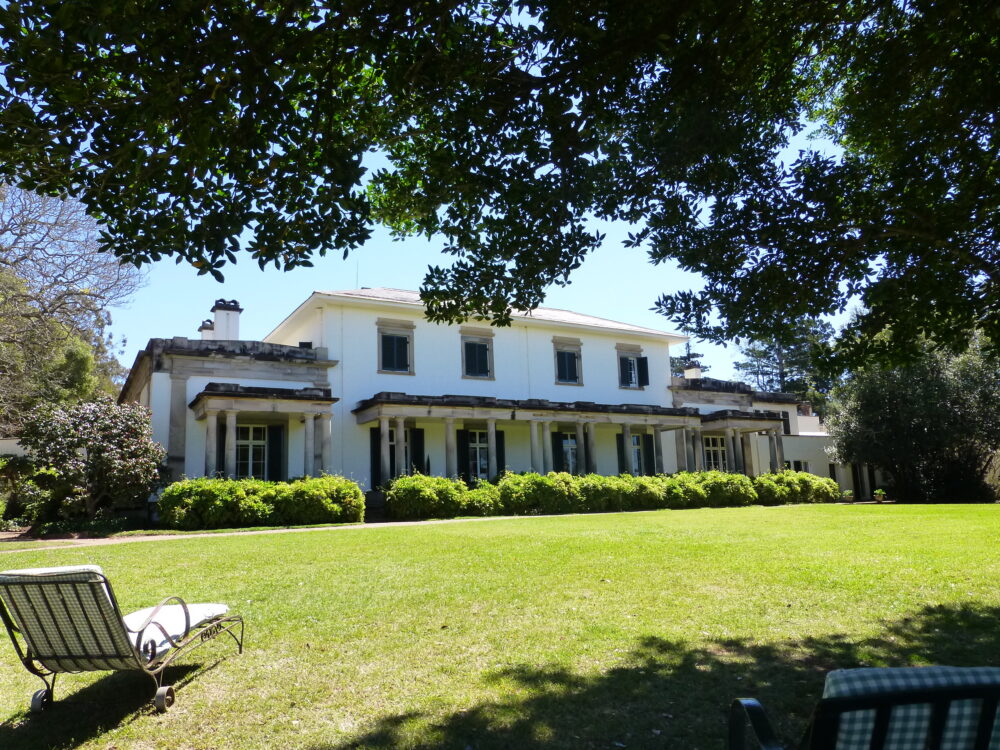
Camden Park’s front garden under a palo blanco
Old gardens can be vital conservation resources for plants endangered or extinct in the wild. A fine example is Camden Park Estate, south of Warrane/Sydney, where three such plants have been conserved: the macadamia, the Chilean wine palm and the palo blanco.
Macadamias are an international industry built on an extremely narrow genetic base – one pest or disease could be disastrous. In the wild, all four species are endangered. Only Australia has these remaining in the wild, mostly in remnant forest patches between the coast, New South Wales’s Richmond River and Queensland’s Bulburin National Park.
Macadamia integrifolia, the key species of commerce, is restricted to rainforest or its margins from the Gold Coast to Mount Bauple. ‘Bauple’ is one local Aboriginal name for it – others are baphal, barpul, boppul and popple. In 2020, Macadamia integrifolia was listed on the IUCN (International Union for the Conservation of Nature) Red List of Threatened Species as vulnerable, with remaining habitat fragmented and threatened by invasive vines. Macadamia ternifolia and Macadamia tetraphylla are listed as endangered, with fewer than 3,000 mature individuals of each remaining. The fourth species, Macadamia jansenii, was only recognised as such in 1992 – about 100 trees are known from one wild location west of Bundaberg.
The oldest known cultivated macadamia trees may hold genes useful for boosting resilience in the industry (through hybridisation), for regenerating habitat and bolstering wild populations. Brisbane’s City Botanic Gardens has an 1858 ‘Walter Hill’ macadamia tree, named for its first superintendent and curator. Camden Park at Menangle, south-west of Sydney, established by William Macarthur, has one from the 1840s.
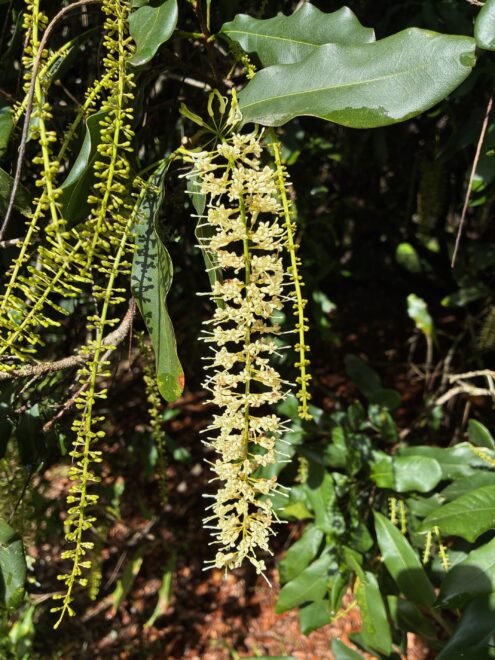
Macarthur was in contact with explorers Allan Cunningham and Ludwig Leichhardt, who traversed macadamia country in the 1820s and 1840s, respectively. Numerous plants in the Camden Park garden came from John Carne Bidwill, a naturalist who explored widely and the Commissioner of Lands for Wide Bay in the late 1840s. While there are no planting records, the Camden Park tree is understood to have been collected from a population south of the Brisbane River. This population of trees was mostly cleared in the construction of Brisbane. The species is now only found at Mount Cotton and Whites Hill. Genetic testing shows the Camden Park tree to share 78 per cent of traits with this lost Brisbane clade.
Propagating these early trees is important, which is why Australia’s macadamia industry has invested funds to understand the plight of these species and develop a conservation plan for their rescue and future – possibly a global first. Camden Park Estate head gardener Trish Restante and horticulturist Euan Mills have worked with the Australian Botanic Garden, Mount Annan and others on this project. In 2024, Denise Bond from Wild Macadamia Conservation (formerly the Macadamia Conservation Trust) delivered cuttings from the Camden Park specimen to Brisbane City Council. Most went into restoration plantings on reserves along Bulimba Creek (former macadamia habitat), although one has been reserved for planting at the Brisbane Botanic Gardens Mt Coot-tha as part of an insurance planting (in case the species goes extinct in the wild) and a source of cuttings for the lost Brisbane clade.
Chilean wine palms (Jubaea chilensis) come from the central Chilean woodlands at the foothills of the Andes, up around 1,400 metres above sea level. In Chile, this species is listed as vulnerable, with approximately 120,000 trees left in the wild. Collecting sap (used in wine and cooking) from these trees requires felling them – hence the numbers allowed to be harvested are now limited by law.
More than 50 of these trees grace Camden Park’s garden and estate, some in a grove south-east of the main house, in the house garden and adorning the Macarthur family cemetery on a nearby ridge. This might be Australia’s largest collection of this species. These trees were here in 1853, when Macarthur donated some to Sydney Botanic Gardens. The palms are slow growing but long-lived, with fat, tapering clean trunks to 25 metres tall, silvery blue-green fronds and fleshy yellow fruit with edible kernels (known as ‘pygmy coconuts’). Hundreds of seedlings were propagated by Euan Mills and sold to the National Arboretum of Australia in Canberra. They were planted in 2012 as ‘Forest 26’, one of the arboretum’s 100 forests, many of which feature endangered species.
Another rare resource at Camden Park is the palo blanco (Picconia excelsa), an endangered cousin of the olive from the Canary Islands. This species is found on the cliffs of five of the islands in much reduced ‘laurisilva’ (laurel rainforest) – and nowhere else. Trees can reach up to 10 metres in height, with canopies that spread even wider – leaves are leathery and glossy, flowers white, and the plant’s fruit is similar in appearance to olives. Camden Park’s shrubberies house several large specimens, and an additional tree shades the house’s rear lawn.
Historic gardens are not just interesting to visit, they often hold plants that may have become extinct or rare in the wild – and in cultivation (as sources of seeds, cuttings, suckers) they can become propagation resources. Camden Park is one example that others could emulate, where gardeners and garden volunteers are playing an active role in sustaining rare historic plantings and replanting progeny.
This article first appeared in Landscape Australia, 2 February 2026.