
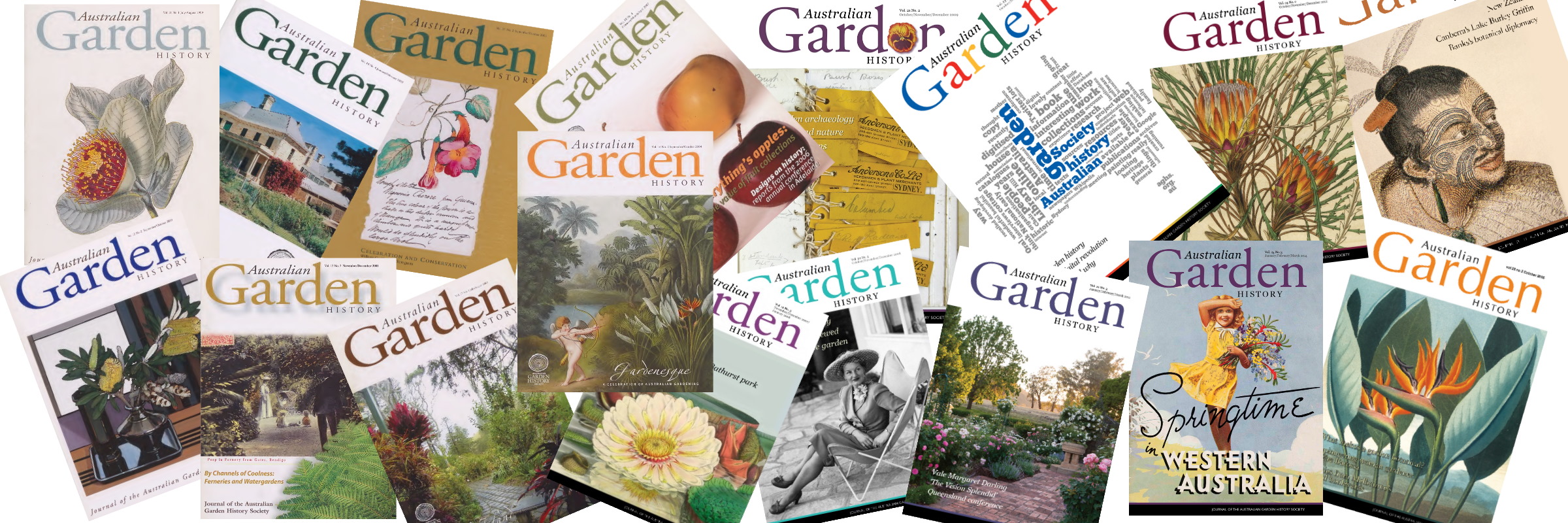
Australian Garden History, the Society’s journal, was first published in 1989. It has continued as it started, striving to maintain a dialogue between professional and amateur interests in the history of gardens, thus showcasing the many aspects of the landscape and its intersection with Australian life.
Media Releases
December 2025 - Pushing the boundaries of garden history
September 2025 - Gardens and memory
June 2025 - The importance of trees
March 2025 - Ways of seeing landscape
December 2024 - Garden transmissions
September 2024 - People and plants
July 2024 - Restoring and recording gardens
March 2024 - Lest we forget
December 2023 - Déjà vu: recurring themes in gardens and landscape history
September 2023 - Highlighting design
June 2023 - Celebrating camellias
March 2023 - From Gondwana to mid-20th century modern
January 2023 - The diverse histories of gardens
September 2022 - Knowing our landscape
June 2022 - Collating the past
March 2022 - The flow of ideas
6 January 2022 - Against the odds
20 September 2021 - Being seen to conserve
1 June 2021 - A picture is worth a thousand words
31 March 2021 - Dare to dream
5 January 2021 - Gardens are great
16 September 2020 - How gardens and landscape shape our identity
13 August 2020 - Gardens and their history offer solace during COVID-19
Indices of Journal Articles
The index to Australian Garden History makes it easy to find articles, gardens and other gems contained in volumes 1–20.
Compiled by AGHS member Kirstie McRobert, this comprehensive index covers issues of the Australian Garden History Journal from 1989-2009.
Download:
Australian Garden History Index, Volumes 1–20 — Australian Garden History Society.
For a limited search of online journal extracts, enter a word of interest here ...
Donate to the Nina Crone Writing Fund

If you would like to encourage new writing talent and promote interest in garden history by donating to the Nina Crone Writing Fund, please click here for details.
History of the Journal
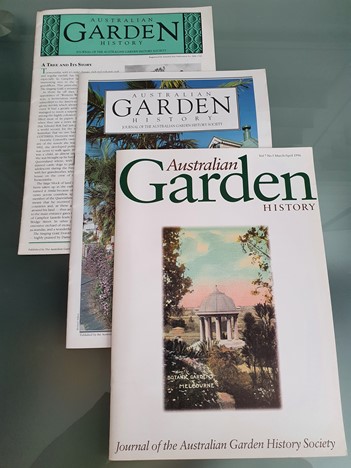
Nancy Clarke, AGHS ACT Monaro Riverina Branch, sets out the history of Australian Garden History in this paper,
History of the Australian Garden History Society Journals.
Getting Published in the Journal
Guidelines for submission to Australian Garden History Journal
Copy deadlines for article submission to Australian Garden History Journal
| January issue | end of October |
|---|---|
| April issue | end of January |
| July issue | end of April |
| October issue | end of July |
Authors: please note that planning for future issues takes place well before these deadlines. You are advised to contact the editor as early as possible about your intention to submit.
Advertise in the Journal
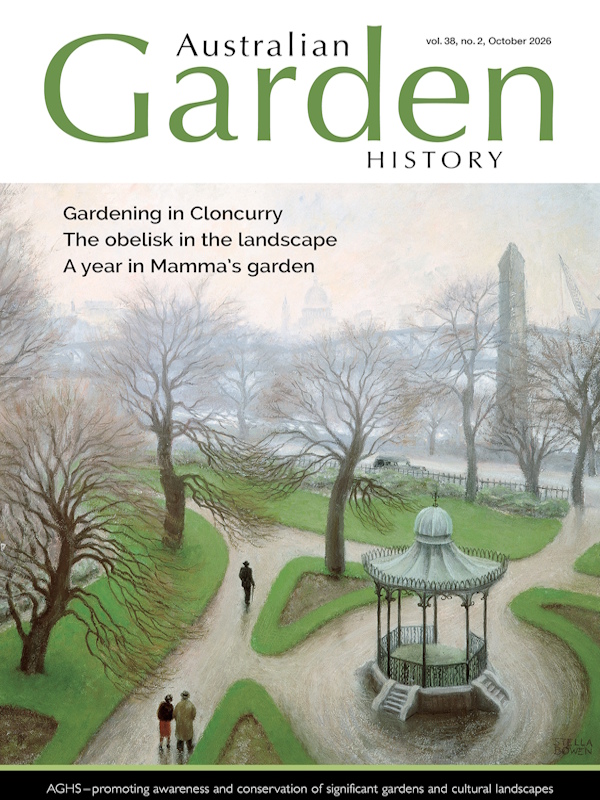




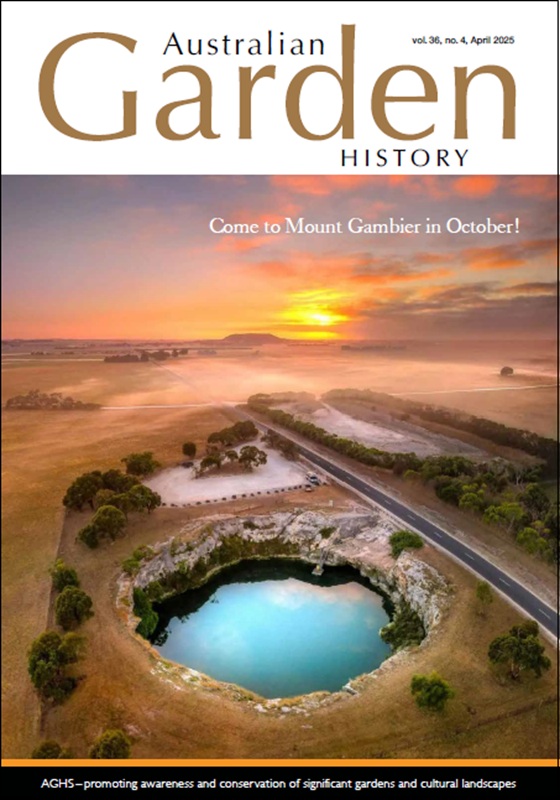
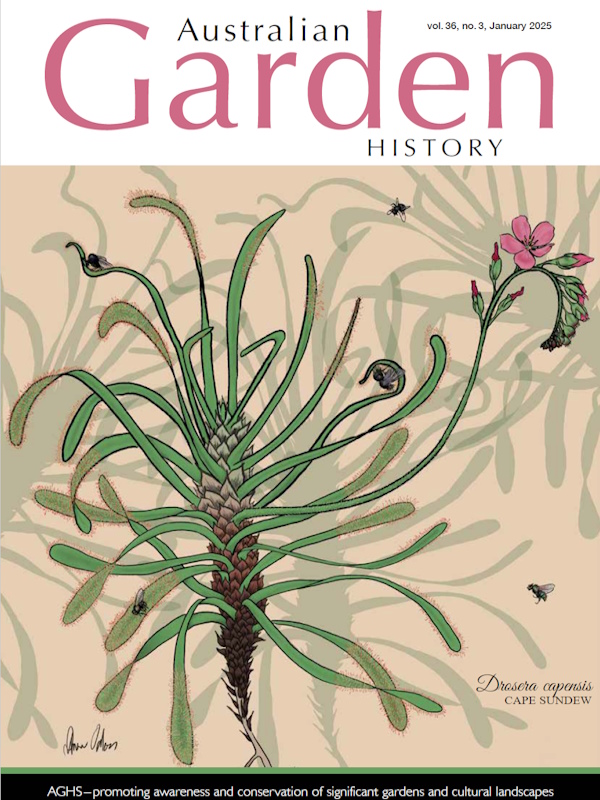
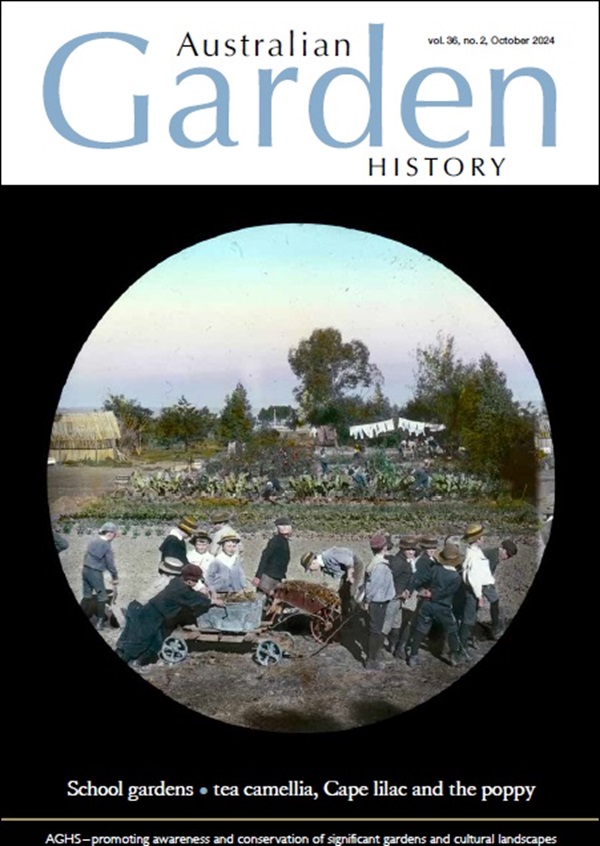
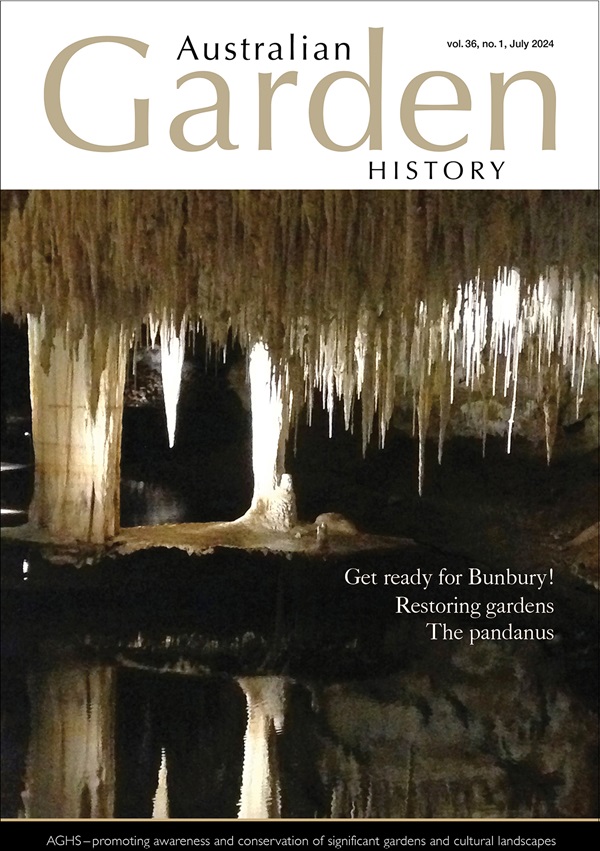
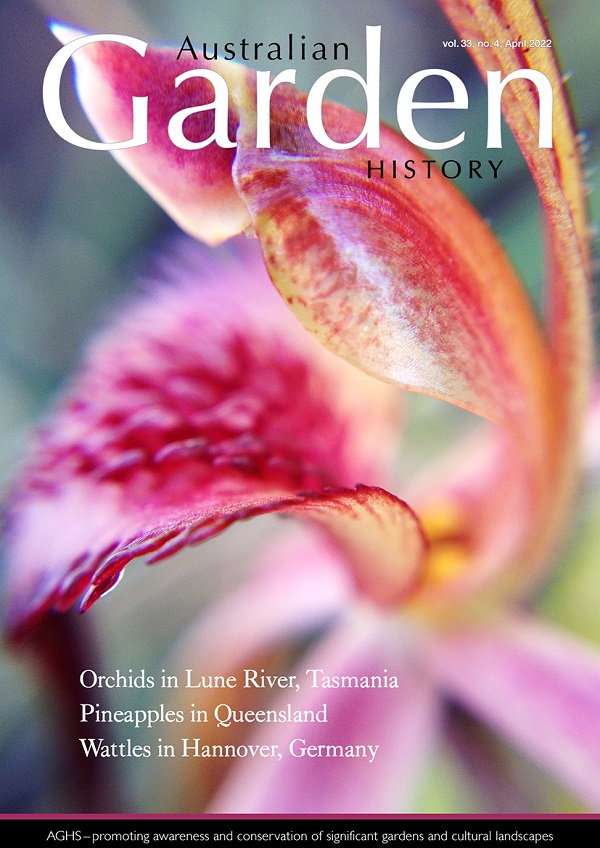
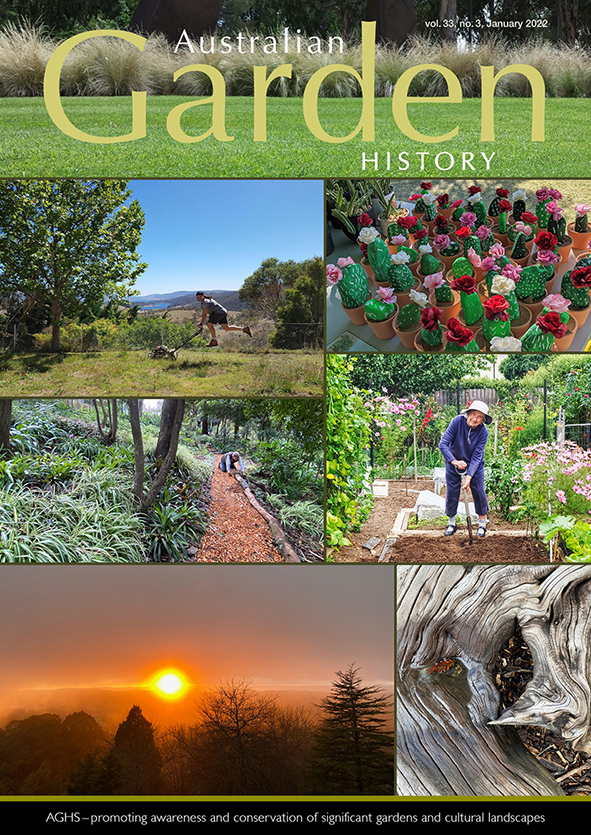
This Season
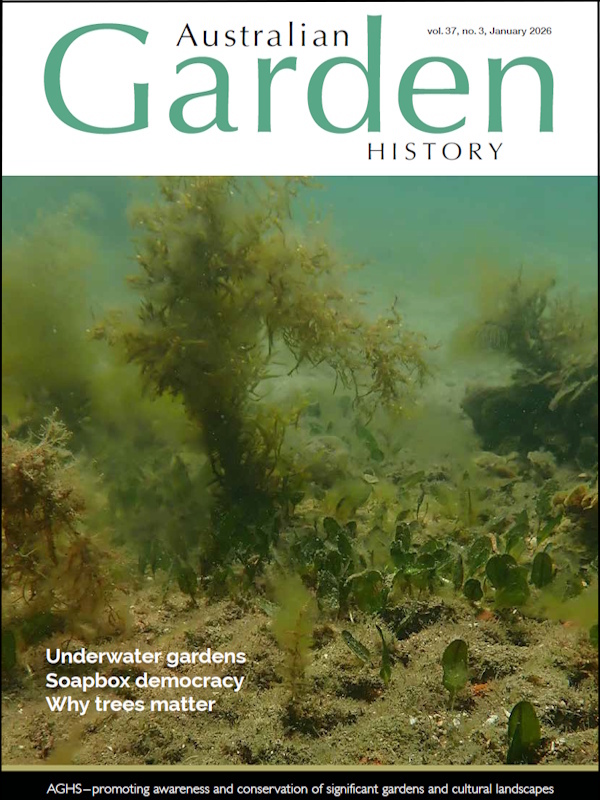
AGH Vol. 37 No. 3 January 2026
Contents
Unmoored gardens – Reading Sydney Harbour below the tideline Ben Hardy-Clements
At high tide in Homebush Bay, the rusted hull of the SS Ayrfield lies half-submerged, its steel frame supporting dense thickets of Avicennia marina. Pneumatophores thread through rivets once intended to make the ship impermeable. Launched in 1912, the vessel later served in the Second World War before returning to civilian life. Decommissioned in 1972, it settled into the shallows, partially sank and gradually became overgrown. The scene is often photographed as an oddity, described by The Sydney Morning Herald in 2020 as ‘the strange Sydney Harbour shipwreck that grew a forest’. Seen this way, the Ayrfield functions less as a ruin and more as a kind of garden, a post-industrial relic that has become both habitat and monument, where decay and renewal unfold within the same frame.
The Goulburn Jewish Cemetery – History, heritage and landscape Siobhán Lavelle
The Goulburn Jewish Cemetery and cultural landscape was included in the New South Wales State Heritage Register in 2021 (SHR item #2052). It is also listed as a local heritage item. These listings recognise that, today, the place is more than just a collection of surviving tombstones.
The singular – Adansonia gregorii Francesca Beddie
In October I attended the Professional Historians Association biennial conference in Darwin. The venue was the newly opened Library & Archives NT, co-located in the Charles Darwin University city campus. This complex of learning stays true to the earlier building on the site: the original Darwin Primary School and later the Darwin Adult Education Centre.
Nurturing gardens of opportunity – Lineage thinking among Cantonese vegetable growers Christopher Cheng
Cantonese vegetable growers in Australia grew more than crops; they cultivated opportunity. Their gardens were springboards to prosperity for families both in Australia and southern China. At the heart of this was lineage thinking – a deep commitment to family continuity where
every action and sacrifice honoured the hope of a better future. Revealing this history is challenging. Colonial surveillance of the Chinese, driven primarily by xenophobia, generated a vast amount of paperwork – certificates, registrations, immigration forms – but the records are riddled with inconsistencies and mistakes.
Soapbox democracy – From the agora to virtual reality Gweneth Leigh
Each Sunday from 2pm, an assortment of fold-out chairs, step ladders and eccentric personalities descend on a wedge of lawn in The Domain in Sydney. Known as Speakers’ Corner, it is a place where all are welcome to air their introspections and irritations. Those with something to say mount low step ladders or perch with placards along the sidewalk; hecklers hover close by. Their demure attire is misleading as these baby boomers are anything but bland. On a sunny afternoon, they will spark and barrack for hours on matters from religion to alien life forms.
Restoring Ben Chifley’s Bathurst Garden – A tribute to a frugal couple Jo Dicksen
The New South Wales regional city of Bathurst is steeped in history. It was the first European inland settlement in Australia, saw the first declaration of martial law in the country and houses one of the most famous motor racing circuits – Mount Panorama. Nestled in the shadow of the iconic mountain is a small, semi-detached home built in 1890. This unobtrusive building reflects the attitude of its most famous inhabitant – Australia’s 16th Prime Minister, Joseph Benedict Chifley, known as Ben. Humble and steadfast, he shared this home with his wife, Elizabeth, from the time they were married in 1914 until his death in 1951.
Profile – Ursula Sharman
Gardens have always been a part of my life. Some of my earliest memories are of school holidays spent at my uncle and aunt’s rose nursery, wandering between rows of blooms and being captivated by their shifting colours and perfumes. I was inspired by my late Oma, who tended her garden with devotion, and by my grandad, who grew a remarkable abundance of vegetables, insisting we eat everything he harvested. Yet gardens were more than flowers, scents and edible delights. They were places where my imagination would flourish. I would tell school friends that I had the Magic Faraway Tree growing in my backyard; they were often disappointed when their imaginations failed to conjure the same.
Beyond the garden fence – 45th annual conference: a note from the Committee Dot Evans
One of the factors that made the Mount Gambier conference unique was the variety of experiences offered, everything from modest Victorian cottage gardens to grand estates, private vineyards, pine forests, garden-related industries and volcanoes. We were a bit apprehensive about how the Biogro recycling visits would be received, after all they were not gardens, but to many people they were the highlight of the visits.
For the bookshelf – Groundwork: the art and writing of Emily Cumming Harris – Michele Leggott and Catherine Field-Dodgson Reviewed by Dr Clare Gleeson
Books on botanical artists are always a feast for the eye but Groundwork: the art and writing of Emily Cumming Harris is more delicious than most. Groundwork contains 200 watercolours and oils of New Zealand flora by Harris as well as scenes and landscapes painted by her, watercolours by family members, photographs and other images. All woven together, they give a wonderful account of Harris’s life. Harris was a poet as well as an artist and the text incorporates several of her poems and excerpts from her diaries.
For the bookshelf – Saving Orchids: Stories of species survival in a changing world – Philip Seaton and Lawrence Zettler Reviewed by Dot Evans
This is one of the most enjoyable books I have read for a long time. Although it is about orchids, the story the authors tell is relevant to our care of the Earth. Orchids, they say, are one of nature’s ‘canaries in the coal mine’, giving an early warning against catastrophic environmental degradation.
Trees – AGHS theme for 2026 Eleanor Dartnall and Caroline Grant
The Australian Garden History Society has adopted trees as a focal point in 2026. What this means at the individual Branch level will depend on local circumstances, partnerships and capacity. Here Eleanor Dartnall and Caroline Grant write about why old trees are important to individuals, communities and the Society. They hope these pieces will stimulate discussion across the Society and beyond.
Remarkable gardens – Broughton House and Garden Kirkcudbright, Scotland Anne Smith
On a trip in the United Kingdom in May 2024, my husband Graham and I were delighted to discover a gem of a garden. Navigating the countryside via the National Trust for Scotland map (a great way to locate old gardens and buildings), we headed to Kircudbright in southwest Scotland to visit Broughton House and Garden. Kirkudbright is a fishing port in Dumfries and Galloway on the estuary of the River Dee. Many artists have based themselves there.
Good news – Blue plaque for Sorensen Stuart Read
New South Wales has a recent system of ‘blue plaques’, that picks up on the London tradition, and the green plaques of Sydney earlier in the 20th century. They honour people, places, events and stories across the state that represent significant contributions to history and culture. Occasional calls are put out to the public to nominate more places for possible plaques. In 2024, I put in a nomination for a plaque to master landscape designer, Paul Sorensen.
From the chair Helen Oates
AGHS national oral history collection – Peter Holmes Interviewed by Myfanwy Thompson
Peter Holmes was interviewed by Myfanwy Thompson in 2003 at the Paul Sorenson designed garden at Mereworth at Berrima in the Southern Highlands, which Sorensen completed between 1962 and 1964. Holmes was the head gardener and then manager at Mereworth for 35 years, when it was owned by the Oxleys. It is now owned by Roy Medich.

Leave a Reply
You must be logged in as a member to post a comment.